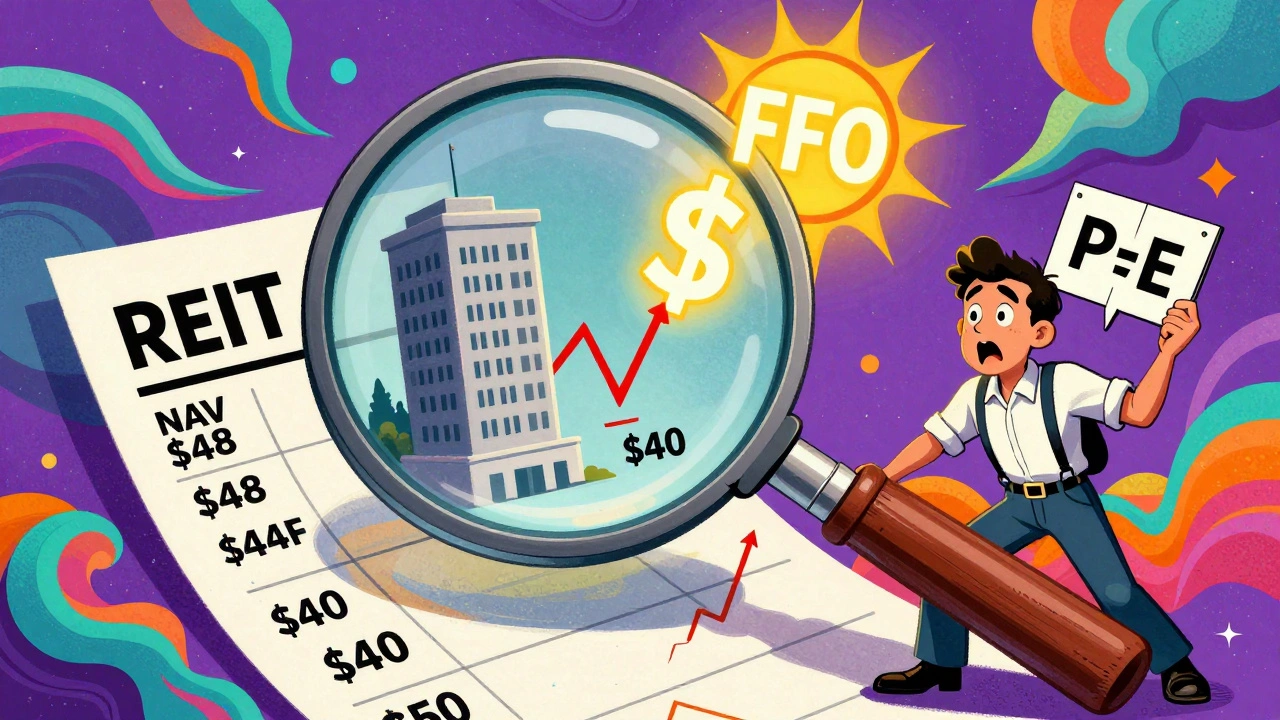
Most people think stocks are valued the same way no matter what. You check the price, look at earnings, maybe compare P/E ratios. But if you’re investing in a REIT, that approach will mislead you. Real Estate Investment Trusts aren’t regular companies. They own buildings-apartments, warehouses, offices, data centers-and their financials are built differently. The numbers you see on a traditional income statement don’t tell the real story. That’s why smart investors skip P/E ratios entirely and turn to three key metrics: Price-to-Book (actually Price-to-NAV), Dividend Yield, and Funds From Operations (FFO).
Why Traditional Metrics Fail for REITs
GAAP accounting forces REITs to depreciate their real estate over decades. That means a building bought for $100 million might show up on the books as $30 million after 20 years-even if it’s now worth $200 million. Net income gets dragged down by this non-cash expense. A REIT could be generating solid cash flow, paying healthy dividends, and still report a loss on paper. That’s why a P/E ratio is useless here. You could see a REIT trading at 50x earnings… and it’s not overvalued. It’s just accounting nonsense.
Enter NAREIT. In 1991, the National Association of Real Estate Investment Trusts created FFO to fix this. They knew investors needed a better way to measure what really matters: cash coming in from operations. Since then, FFO, NAV, and dividend yield have become the standard tools for evaluating REITs. If you’re looking at a REIT without checking these three, you’re flying blind.
Price-to-Book? It’s Actually Price-to-NAV
When you hear "Price-to-Book" for a REIT, don’t think of book value from the balance sheet. That’s outdated. The real "book" is Net Asset Value (NAV). NAV is what the real estate assets are actually worth today-not what they cost 15 years ago.
Here’s how it works: Take the estimated market value of all the properties the REIT owns. Add in any other assets like cash or land. Then subtract all debt. That’s the total NAV. Divide that by the number of shares outstanding, and you get NAV per share (NAVPS). If the stock trades at $40 and the NAVPS is $48, the REIT is trading at a 16% discount. That’s a signal. Maybe the market thinks the properties are overvalued. Or maybe it’s a buying opportunity.
For example, a retail REIT with $5 billion in properties appraised at current market value, $2 billion in debt, and 100 million shares outstanding has a NAVPS of $30. If the stock is trading at $25, you’re paying $25 for $30 worth of assets. That’s a 17% discount. Investors on Reddit’s r/REITs found a similar scenario in 2023 with a mall REIT trading at 0.85x NAV. Six months later, it was bought out at NAV. Discounts like that don’t last long when smart money spots them.
But here’s the catch: NAV isn’t magic. It depends on cap rates-the return investors expect from a property’s net income. If a REIT’s portfolio generates $500 million in net operating income and you use a 5% cap rate, the portfolio is valued at $10 billion. Change the cap rate to 5.5%, and the value drops to $9.09 billion. A half-point shift can change NAV by 10% or more. That’s why institutional investors use detailed property-level data and cap rate benchmarks from sources like RCA and MSCI.
Dividend Yield: The Hook, Not the Whole Story
REITs have to pay out at least 90% of their taxable income as dividends. That’s the law. So high yields are common. You’ll see REITs yielding 5%, 6%, even 8%. It’s tempting. But a high yield can be a trap.
One investor on Bogleheads bought a REIT paying 10% because the yield looked amazing. Six months later, the dividend got cut. Why? The payout ratio-dividends divided by FFO-was 112%. That means they were paying out more than they were earning. They were dipping into cash reserves or selling assets just to keep the dividend alive. That’s not sustainable. That’s returning your own capital.
Real investors look at dividend yield alongside FFO coverage. A healthy REIT typically pays out 70% to 85% of its FFO as dividends. That leaves room for maintenance, acquisitions, and growth. According to NAREIT, the average dividend yield for all equity REITs between 2010 and 2020 was 3.6%. That’s nearly double the S&P 500’s average. But within that, there’s huge variation. Healthcare REITs might yield 4.5% because they own hospitals with stable tenants. Data center REITs might yield just 2.5% because investors expect high growth and are willing to trade yield for appreciation.
Use dividend yield as a screen, not a decision. If it’s above 6%, dig deeper. Check the FFO payout ratio. If it’s over 90%, walk away.

Funds From Operations (FFO): The Real Profit Measure
FFO is where the rubber meets the road. Start with GAAP net income. Then add back depreciation and amortization on real estate. Add back losses from property sales. Subtract gains from property sales. That’s FFO. It strips out the accounting noise and shows you what the business actually earns from renting out buildings.
Imagine a REIT reports $100 million in net income. But it added back $150 million in depreciation. Its FFO is $250 million. Now the picture changes. That’s real cash flow. Investors pay for that. The Price-to-FFO ratio tells you how much you’re paying for each dollar of this real earnings power. As of mid-2023, the median P/FFO for U.S. equity REITs was 18.5x. Residential REITs traded around 22x. Retail REITs were at 14.8x. That’s not random. It reflects growth expectations and risk.
But even FFO isn’t perfect. It doesn’t account for recurring capital spending-roof replacements, elevator upgrades, HVAC repairs. That’s where AFFO (Adjusted FFO) comes in. AFFO subtracts those necessary maintenance costs. It’s a cleaner view of cash available for dividends. Most top-performing REITs now report AFFO. It typically runs 10% to 15% lower than FFO.
Look for consistent FFO growth. The best REITs grow FFO 5% to 7% a year. That comes from raising rents, filling vacancies, or buying better properties. If a REIT’s FFO has been flat or declining for two years, the dividend might look high-but it’s probably not safe.
Putting It All Together: The REIT Investor’s Checklist
You don’t need to be a Wall Street analyst to evaluate a REIT. Just follow this simple process:
- Find the P/FFO ratio. Is it below the sector average? For example, if retail REITs average 15x and this one’s at 12x, it’s cheaper than peers.
- Check the dividend yield. Is it above 5%? If so, go to step three.
- Calculate the FFO payout ratio. Divide annual dividend per share by FFO per share. If it’s over 90%, skip it.
- Look at the NAV discount or premium. Is the stock trading below NAV? If it’s 10% or more below, that’s a potential value signal-unless there’s a reason (like bad tenants or declining markets).
- Check FFO growth over the last three years. Is it positive? Is it accelerating?
Use this framework and you’ll avoid the traps. High yield? Fine-but only if it’s covered. Low P/FFO? Great-but only if FFO is growing. A discount to NAV? Even better-if the underlying properties are in strong markets.
What the Experts Say-and What They Warn
Joshua Miramant from Wall Street Prep calls NAV "the anchor valuation metric for REITs." He’s right. It’s the only way to know if you’re paying too much for the real estate underneath. But even he warns: "NAV is only as good as your cap rate assumptions." One wrong number can throw everything off.
Aswath Damodaran from NYU Stern says cap rate changes can swing NAV by 10-15%. That’s huge. So don’t rely on one number. Look at trends. Are cap rates rising in the REIT’s market? That’s a red flag. Are they falling? Maybe the market is tightening, and values are going up.
The consensus? Use all three metrics together. FFO tells you if the business is healthy. Dividend yield tells you the income you’re getting. NAV tells you if the price reflects the real value of the assets. Ignore one, and you’re gambling.

Where to Find the Data
You don’t need a Bloomberg terminal. Most REITs report FFO, AFFO, and dividend data in their quarterly earnings releases. NAV isn’t always listed, but you can calculate it yourself if you know the property values and debt. NAREIT offers free templates and guides on their website. For deeper analysis, services like Green Street Advisors and Real Capital Analytics provide proprietary NAV estimates-but they cost money.
For retail investors, start with the REIT’s investor relations page. Look for the "Funds From Operations" section. Compare P/FFO across peers. Check the dividend payout ratio. Then ask: Is this REIT trading below its estimated asset value? If yes, and FFO is growing, you might have something.
Final Thought: REITs Are About Cash, Not Earnings
REITs aren’t tech startups with burn rates. They’re cash machines. Their value comes from steady rent checks, not flashy innovation. That’s why metrics like FFO and NAV matter more than quarterly earnings surprises. A REIT that grows FFO 6% a year, pays 80% of it as dividends, and trades at 0.9x NAV is a better investment than one with 20% earnings growth but a 110% payout ratio and a 20% premium to NAV.
Don’t get fooled by the headline yield. Don’t trust the GAAP earnings. Look at the cash. Look at the assets. Look at the growth. That’s how you invest in REITs the right way.
What’s the difference between FFO and AFFO?
FFO (Funds From Operations) starts with net income and adds back real estate depreciation and property sale gains/losses. It’s the standard measure of REIT earnings. AFFO (Adjusted FFO) goes further by subtracting recurring capital expenditures-like roof repairs, elevator upgrades, and HVAC replacements-and straight-line rent adjustments. AFFO gives a clearer picture of the actual cash available to pay dividends. Most top REITs now report both, but AFFO is becoming the gold standard for assessing long-term dividend sustainability.
Why is NAV more important than book value for REITs?
Book value is based on historical cost-what the property was bought for years ago, minus depreciation. That number is often way below what the property is worth today. NAV (Net Asset Value) uses current market appraisals. It estimates what the real estate would sell for right now, based on current rental income and cap rates. That’s why NAV is the real "book value" for REITs. A REIT trading at 0.8x NAV means investors believe the assets are undervalued. Trading at 1.2x NAV means the market expects future growth.
Can a REIT have a negative P/E ratio and still be a good investment?
Yes, and it’s common. Because GAAP accounting forces REITs to deduct large depreciation expenses, many report net losses-even when they’re generating strong cash flow. A negative P/E ratio is meaningless for REITs. Instead, look at P/FFO. A REIT with negative net income but positive FFO is perfectly fine. In fact, it’s often a sign the company owns valuable real estate with low operating costs. Ignore P/E. Focus on FFO and NAV.
What’s a healthy dividend payout ratio for a REIT?
A healthy payout ratio is between 70% and 85% of FFO. That means the REIT is distributing most of its cash flow as dividends, but still keeping enough to cover maintenance, pay down debt, or buy new properties. If the payout ratio exceeds 90%, the dividend is at risk. If it’s over 100%, the REIT is paying out more than it earns-likely dipping into cash reserves or selling assets. That’s unsustainable and often leads to dividend cuts.
How do interest rates affect REIT valuation metrics?
Rising interest rates push up cap rates, which lowers NAV. If investors demand higher returns from real estate, property values drop. That can make REITs look more expensive on a P/FFO basis, even if earnings are stable. Also, higher rates increase borrowing costs, which can hurt growth if the REIT needs to finance new acquisitions. On the flip side, REITs with fixed-rate debt and long-term leases are more insulated. The key is to look at the balance sheet-low debt and long lease terms help weather rate hikes.
Next Steps for Investors
If you’re new to REITs, start by picking one from a sector you understand-like apartments or warehouses. Look up its latest earnings report. Find the FFO and dividend numbers. Calculate the payout ratio. Check the stock price against the estimated NAV (many sites like NAREIT or Simply Wall St provide estimates). Compare it to other REITs in the same sector. If it’s trading below NAV, has a payout ratio under 85%, and FFO has grown over the last three years, you’ve found a candidate worth deeper research.
Don’t chase yield. Don’t ignore NAV. And never rely on GAAP earnings. Stick to the three metrics that actually matter: Price-to-NAV, Dividend Yield, and FFO. That’s how you invest in real estate without owning a single building.
Robert Shurte
December 9, 2025 AT 01:08It’s funny-how we’ve built entire financial systems on assumptions that are, at their core, arbitrary. Depreciation? A 30-year timeline for a building that could last 100? It’s like measuring a river’s flow by counting how many leaves have floated past… and then pretending the water’s volume hasn’t changed.
FFO isn’t just a metric-it’s a philosophical correction. It says: ‘Stop pretending accounting rules are reality.’ NAV? That’s the real balance sheet-the one written in brick, mortar, and rent checks.
And yet… we still cling to P/E. Why? Because it’s familiar. Because we’d rather be wrong together than right alone. The market doesn’t punish ignorance-it rewards conformity.
I wonder if future historians will look back at this era and laugh at how we valued real assets using paper numbers. Maybe they’ll have a metric for ‘truth-to-illusion ratio.’
Until then, I’ll keep checking NAV, FFO, and the quiet hum of tenants paying rent. That’s the only truth left.
Mark Vale
December 9, 2025 AT 15:41you know what’s sus? the fact that all these ‘NAV’ calcs are based on ‘appraisals’ from the same firms that work with the REITs themselves. it’s like asking your landlord to rate his own house… then selling you shares in it.
and don’t get me started on ‘cap rates’-they’re just guesses dressed up as science. one year it’s 5%, next year it’s 6.5% because ‘market conditions’-which means someone at a big bank changed their mind.
FFO? sure. but who’s auditing the ‘maintenance’ deductions? i’ve seen REITs claim $20M in ‘capital spend’… then turn around and buy a new building for $18M. coincidence? i think not.
the truth? this whole system is a confidence trick. the numbers are malleable. the ‘experts’ are paid by the same people they’re rating. and you? you’re just the sucker holding the bag when the cap rate flips.
but hey… at least the dividends look nice on paper. 😏
Royce Demolition
December 10, 2025 AT 06:51YESSSSS THIS IS WHY I LOVE REITS 🚀💸
FFO is the REAL MVP-no cap. P/E is just accounting magic smoke. NAV? That’s the actual treasure map. And when you see a REIT trading at 0.85x NAV with 6% yield and FFO growing? THAT’S A BULLSEYE. 🎯
I bought a data center REIT last year at 16x P/FFO. Now it’s at 20x. FFO up 12%. Dividend increased. NAV still climbing. I’m not just making rent-I’m riding the future.
Stop chasing yield. Start chasing CASH FLOW. And if you don’t know what AFFO is? GO LEARN IT. Your portfolio will thank you. 💪📈
REITs aren’t stocks. They’re rent machines. And machines don’t lie. 💯
Sabrina de Freitas Rosa
December 11, 2025 AT 10:18Oh honey, you’re telling me people still use P/E for REITs? 😒
That’s like judging a Ferrari by how much it costs to wash it. You’re not even looking at the engine. You’re staring at the bumper sticker.
And don’t even get me started on those ‘high-yield’ REITs that pay 10%-they’re not investments, they’re financial pyramids with a roof. I saw one last year-dividend cut in six months. Poof. Gone. Like a magician’s rabbit… except the rabbit was your retirement fund.
FFO? NAV? Yeah. That’s the stuff. But don’t just read it-dig into the footnotes. Look for ‘non-recurring items’-that’s where they hide the skeletons.
And if your REIT’s NAV is ‘estimated’ by some guy in a cubicle who’s never stepped foot in a warehouse? Run. Run far. And take your money with you.
Real estate isn’t a spreadsheet. It’s bricks. And people. And leases. And if you’re not seeing that-you’re not investing. You’re gambling. With your life. 💅
Erika French Jade Ross
December 11, 2025 AT 14:41now i check nav, payout ratio, and ffo growth. simple. no drama. no hype.
and yeah-cap rates matter. but don’t stress over 0.5% swings. look at the trend. is rent rising? are vacancies falling? that’s the real signal.
also-thank you for mentioning affo. so many people skip it. it’s the quiet hero. 💛