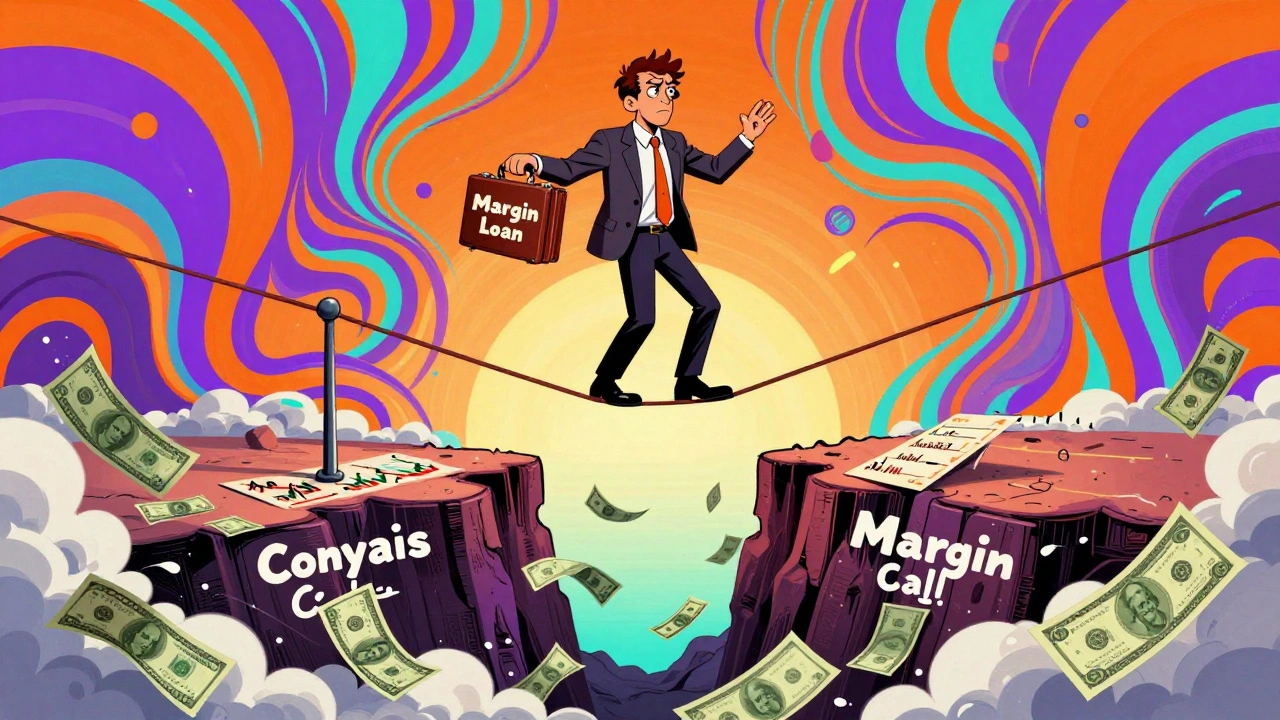
Margin Account Calculator
Investment Details
Risk Assessment
When you open a margin account, you're not just getting more buying power-you're taking on real financial risk that can turn a winning trade into a devastating loss overnight. Unlike a regular cash account where you pay for stocks with your own money, a margin account lets you borrow from your broker to buy more shares. It sounds powerful. But here's the truth: most people who use margin don't make more money. They just lose it faster.
How Margin Accounts Actually Work
A margin account lets you borrow up to 50% of the purchase price of stocks under Federal Reserve Regulation T. So if you want to buy $10,000 worth of stock, you need $5,000 of your own money. The broker lends you the other $5,000. That’s leverage. And leverage cuts both ways.Let’s say you buy $10,000 of stock with $5,000 of your own cash. The stock goes up 20%. You sell it for $12,000. You pay back the $5,000 loan, and you’re left with $7,000. That’s a 40% return on your original $5,000. Sounds great, right?
Now imagine the stock drops 20%. You sell for $8,000. You still owe the broker $5,000. You’re left with $3,000. That’s a 40% loss on your own money. The same 20% market move doubled your gain or loss. That’s the math of margin.
But it gets worse. Brokers don’t wait for you to sell. If your account equity falls below a certain level, they issue a margin call. You have to deposit more cash or sell positions immediately-often at the worst possible time. In March 2020, over 12,500 Robinhood margin accounts got margin calls in a single day. Most had to sell at market lows just to stay in the game.
Interest Costs: The Silent Killer
Every dollar you borrow costs you money. Margin interest isn’t fixed. It changes with market rates and your account size. As of late 2023, Fidelity charges 7.57% on balances under $100,000. Interactive Brokers starts at 4.83% but only for clients with larger balances. Schwab’s rate is around 7.2%. That’s not a one-time fee. It’s compounded daily.Let’s say you borrow $20,000 at 7.5% annual interest. That’s $1,500 per year. Or $125 per month. That’s $125 you need to earn just to break even before your trade even turns a profit. If you’re holding a stock for six months, you need it to rise 3.75% *just to cover interest*. No gains? You’re losing money.
And here’s the trap: many investors forget about interest until their statement arrives. They focus on stock picks, not financing costs. But over time, that interest eats into returns. Professor Burton Malkiel of Princeton found that leveraged strategies underperform unleveraged ones over the long term-not because markets are unpredictable, but because interest compounds like a debt trap.
The Hidden Risks No One Talks About
Most guides warn you about market risk. But the real danger is margin call risk.Brokers set a minimum equity requirement-usually 25% by FINRA rules. But here’s the catch: most major brokers like Fidelity and Schwab enforce 30-40% for regular stocks, and 50-75% for volatile ones like AI or crypto-related stocks. That’s not a suggestion. It’s a rule.
One investor on Reddit shared how he held 35% equity in his account but still got a margin call during the July 2023 AI stock sell-off. Why? His broker’s Risk-Based Requirement (RBR) system added volatility surcharges to his tech holdings. He didn’t break any rules. He just didn’t know the system was recalculating his risk daily.
Another hidden risk? Portfolio margin. If you have over $110,000 in net liquidation value, you might qualify. It calculates risk across your whole portfolio instead of per stock. Sounds better? It is-for professionals. But it also means your entire portfolio can be liquidated at once if the system flags a spike in overall risk. In March 2023, during the regional bank crisis, some portfolio margin accounts saw 20-30% equity drops in a single day. Brokers didn’t ask. They just sold.
And don’t forget day trading. If you make four or more day trades in five business days and have less than $25,000 in your account, you’re flagged as a Pattern Day Trader. Your account gets restricted. No trades until you deposit more cash. Many new traders don’t realize this rule exists until it’s too late.

What Margin Accounts Are Best For (and What They’re Not)
Margin isn’t evil. It’s a tool. Like a chainsaw. Useful if you know how to handle it. Dangerous if you don’t.Here’s where margin makes sense:
- Short-term options strategies (like credit spreads) that require less upfront capital
- Buying high-quality dividend stocks when you want to scale up slowly
- Portfolio rebalancing during market dips when you don’t have cash on hand
Here’s where it’s a bad idea:
- Buying single stocks on margin (especially volatile ones like meme stocks)
- Using it as a substitute for emergency cash
- Trying to “double down” on a losing position to average down
- Investing for retirement with margin debt
A 2023 SEC study found margin account holders lost 23.7% more on average during market downturns than cash account holders. Why? Because they got forced out of positions at the bottom. That’s not investing. That’s gambling with borrowed money.
Best Practices to Survive (and Not Get Wiped Out)
If you’re going to use a margin account, follow these rules:- Never use more than 25-30% of your buying power. That means if your account is worth $100,000, keep your margin debt under $25,000. That gives you room to breathe during volatility.
- Keep 30-50% of your portfolio in cash. This isn’t about being timid. It’s about having liquidity to cover margin calls without selling at a loss.
- Avoid single-stock margin positions. Diversify across 10+ stocks or ETFs. A portfolio of 15 stocks is less likely to trigger a margin call than one stock that drops 50%.
- Calculate your break-even point. If your interest rate is 7.5%, your investment needs to return 7.5% just to cover costs. Factor that into every trade.
- Set your own alerts. Don’t wait for your broker’s margin call. Monitor your equity daily. If it drops below 120% of the maintenance requirement, take action before it’s forced on you.
Charles Schwab recommends active traders keep at least $50,000 in equity to handle normal swings. Long-term investors should keep margin debt below 15% of their total portfolio. That’s not aggressive. That’s smart.
What Happens When Things Go Wrong
Margin calls aren’t warnings. They’re demands. You have two choices: deposit cash or sell positions. Brokers don’t care if the market is crashing. They don’t care if you’re stuck in traffic. They just want their money back.In 2020, during the pandemic crash, 87% of Robinhood margin accounts that received a call had to liquidate immediately. Many sold at the bottom. They lost 30-40% of their portfolio in one day. And they couldn’t buy back in for weeks.
And here’s the worst part: brokers can change margin requirements overnight. During the 2021 meme stock frenzy, several brokers raised maintenance margins on GameStop and AMC from 30% to 100%. Some accounts were liquidated without warning. No one broke the rules. The rules just changed.
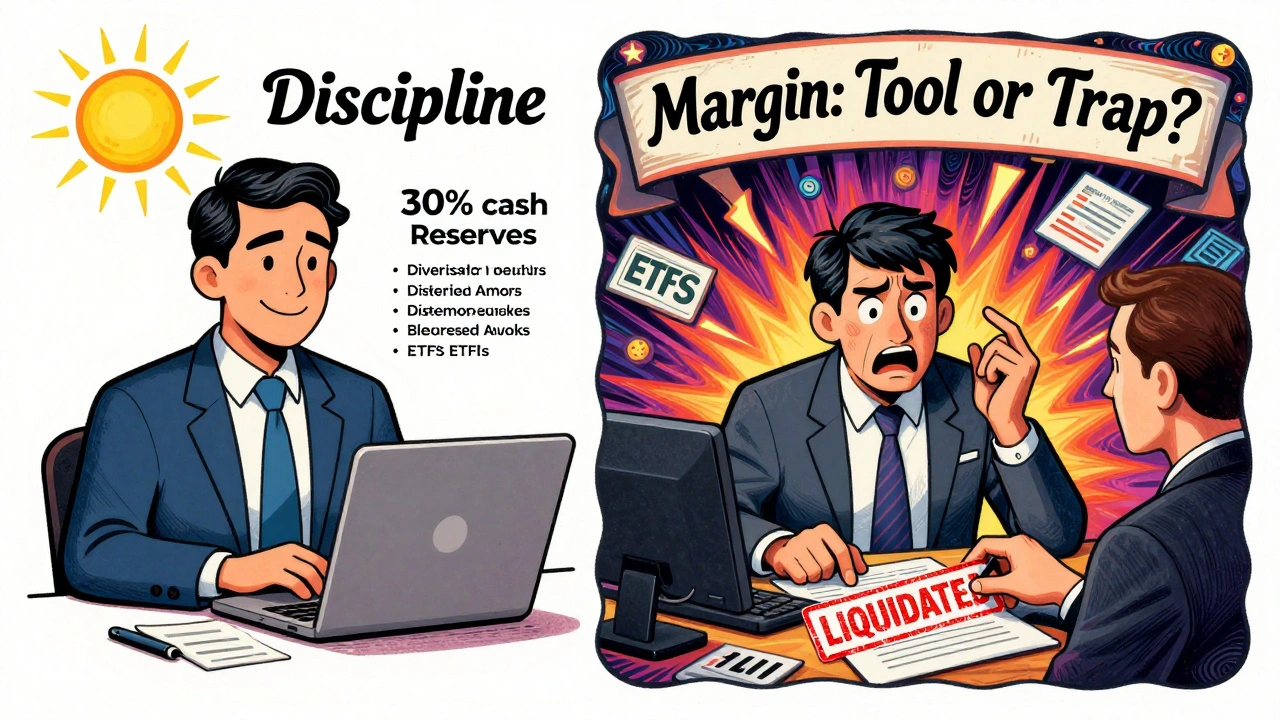
Margin vs. Alternatives
Is there a safer way to borrow against your portfolio? Yes. Securities-Based Lending (SBL) from private banks. You pledge your securities as collateral and get a line of credit. Interest rates are higher-usually prime + 1-2%, so around 8.5-9.5% right now. But there’s a big difference: no daily maintenance calls. You can hold your positions for years. No forced sales.But SBL has its own limits. Minimum loan sizes are often $100,000+. You need to be a high-net-worth client. It’s not for the average retail investor.
For most people, a margin account is the only accessible option. But that doesn’t make it safe. It just makes it available.
Final Reality Check
Margin accounts aren’t for beginners. They’re not for retirement savings. They’re not for “getting rich quick.”They’re for experienced investors who understand volatility, can sleep through market drops, and have the discipline to walk away when things get risky. In 2023, 57% of margin account holders had at least one margin call in the past two years. 12% had positions liquidated automatically.
Most people think margin is about leverage. It’s not. It’s about risk management. The best traders don’t use the full margin. They use just enough to stay in the game-and never let the broker control their fate.
If you’re considering a margin account, ask yourself: Do I have the emotional control to watch my portfolio drop 30% and not panic? Do I have enough cash to cover a margin call without selling my best stocks? If the answer is no, you don’t need a margin account. You need a cash account-and patience.
What happens if I can’t meet a margin call?
If you don’t deposit cash or sell assets to meet a margin call, your broker will sell your positions-often at market prices-to cover the loan. You don’t get to choose what gets sold. The broker picks the most liquid or risky holdings first. You may lose control of your portfolio, and you still owe any remaining balance if the sale doesn’t cover the debt.
Can I lose more than I invested in a margin account?
Yes. If you short a stock on margin and its price rises sharply, your losses can exceed your initial deposit. Brokers protect themselves by requiring higher margin for short positions, but if the market moves fast enough, you can owe more than you put in. This is why shorting on margin is extremely risky and not recommended for most investors.
How is margin interest calculated?
Margin interest is calculated daily based on your debit balance and the broker’s current interest rate. For example, if you owe $20,000 at a 7.5% annual rate, you’re charged about $4.11 per day ($20,000 × 0.075 ÷ 365). This interest is added to your account balance and compounds over time. You’ll see it on your monthly statement.
What’s the difference between initial margin and maintenance margin?
Initial margin is the amount of your own money you need to open a position-usually 50% of the purchase price. Maintenance margin is the minimum equity you must keep in the account after the trade is made-typically 25-40%. If your equity falls below this level, you get a margin call. The initial margin is about buying power. The maintenance margin is about staying in the game.
Do all brokers have the same margin rules?
No. While FINRA sets minimum requirements (25% maintenance, $2,000 minimum account), brokers can-and do-set stricter rules. Fidelity and Schwab often require 30-40% maintenance for equities. Some charge higher rates for smaller balances. Others offer portfolio margin only to clients with $110,000 or more. Always read your broker’s margin agreement before trading.
Is margin trading legal?
Yes, margin trading is legal and regulated in the U.S. by the Federal Reserve Board (Regulation T) and FINRA. Brokers must disclose all risks and requirements before opening a margin account. However, many investors misunderstand the rules, leading to unexpected losses. Legal doesn’t mean safe.
Next Steps: Should You Use a Margin Account?
Ask yourself these three questions:- Have I traded for at least two full market cycles (bull and bear) in a cash account?
- Do I have enough cash reserves to cover a $10,000-$20,000 margin call without touching my emergency fund?
- Am I comfortable losing 30-50% of my portfolio in a single market drop-and still holding on?
If you answered “no” to any of these, stick with a cash account. You’ll sleep better. You’ll lose less. And you’ll still outperform most margin traders over time.
Margin accounts are not a shortcut to wealth. They’re a test of discipline. And most people fail it.
Robert Shurte
December 10, 2025 AT 06:17It’s funny-margin accounts are marketed like a Swiss Army knife, but they’re really just a very sharp knife with no handle… and everyone’s pretending they know how to hold it.
Levity? Sure. But leverage? It’s just debt wearing a tuxedo. The market doesn’t care if you ‘believe’ in the stock. It only cares if you can cover the call.
I’ve watched people turn $50k into $15k in a week because they thought ‘buying the dip’ meant ‘buying more on margin.’ The dip didn’t care. The broker didn’t care. The interest compounded while they scrolled TikTok.
There’s a quiet arrogance in thinking you’re the exception. The math doesn’t care about your hustle. It doesn’t care if you ‘read the news.’ It just multiplies. And subtracts. And calls.
Prof. Malkiel was right: the real edge isn’t in picking stocks-it’s in not borrowing to play.
I keep a cash account. I sleep. I don’t dream in margin calls.
Maybe I’m slow. But slow beats broke.
And I’ve got all my teeth.
Mark Vale
December 10, 2025 AT 12:06Did you know the Fed secretly allows brokers to change margin rules without notice? It’s in the fine print no one reads.
They’re not just collecting interest-they’re setting traps. The 2021 meme stock freeze? That wasn’t a ‘risk adjustment.’ That was a coordinated wipeout.
And who benefits? The big banks. The ones who own the brokers. The ones who got bailed out in 2008.
They want you leveraged. They want you scared. They want you selling low so they can buy back at pennies.
It’s not finance. It’s a casino rigged with algorithms and legalese.
And they call it ‘investing.’
Wake up.
They’re not your friends. They’re not your advisors. They’re the house.
And you’re the sucker with the credit card.
PS: I’ve seen the documents. It’s all legal. That’s the worst part.
Royce Demolition
December 12, 2025 AT 07:16YOOOOO I JUST GOT A MARGIN CALL LAST WEEK AND I THOUGHT I WAS GONNA DIE 😭
BUT I PANICKED AND SOLD MY BTC AND NOW I’M SO MAD 😤
SO I DEPOSITED $8K CASH AND BOUGHT MORE SPY AT THE BOTTOM 🚀
AND NOW I’M UP 18% IN 3 WEEKS!!! 🤑
MARGIN ISN’T THE PROBLEM - IT’S THE FEAR!!
YOU GOTTA HAVE GUTS. YOU GOTTA HAVE A PLAN.
IF YOU’RE NOT LIVING ON THE EDGE, YOU’RE TAKING UP TOO MUCH SPACE!! 🌪️🔥
PS: I’M 24 AND I’M BUILDING MY FIRST MILLION. YOLO!! 💪💰
Sabrina de Freitas Rosa
December 13, 2025 AT 16:02Oh honey. You think you’re smart using margin? You’re just a walking debt balloon with a Robinhood app.
You’re not ‘leveraging.’ You’re borrowing money to gamble on memes while your rent’s late.
I’ve seen it a hundred times. Young guy. New account. Thinks he’s Warren Buffett. Then he gets a call. Then he cries. Then he blames the market.
Here’s the truth: you don’t need margin. You need a job. You need savings. You need to stop trying to be rich in 6 months.
And if you’re using it to ‘average down’ on a losing stock? That’s not investing. That’s financial self-harm.
Put the credit card down. Go for a walk. Eat something real. And come back when you’ve got more than hope in your pocket.
Love you. But you’re gonna lose everything if you keep this up.
And I’ve seen it. I’ve seen it all.
Erika French Jade Ross
December 14, 2025 AT 02:33