
Debt vs. Investing Calculator
High-Interest Debt Input
Investment & Savings
Recommended Allocation
Enter your debt and savings details to see recommended allocation
Should You Invest or Pay Off Debt First?
If you’ve ever looked at your bank account and wondered whether to put extra money into stocks or crush your credit card balance, you’re not alone. In 2025, nearly 8 in 10 Americans under 45 face this exact choice every month. And there’s no one-size-fits-all answer-but there is a smarter way to decide.
The key isn’t just about numbers. It’s about your situation, your stress level, and the real math behind what grows your money faster. Let’s cut through the noise.
The 6% Rule (It’s Still the Best Starting Point)
Most financial advice gets complicated fast. But here’s the simplest rule that works for most people: If your debt interest rate is 6% or higher, pay it off first. If it’s below 6%, start investing.
This isn’t a guess. It’s based on 30+ years of market data. The S&P 500 has returned about 7-8% annually since 1957, but that’s before taxes, fees, and volatility. When you factor in those things, a 6% threshold gives you a solid buffer. If your credit card charges 24.7% (the national average as of late 2023), you’re losing far more in interest than you’ll ever make in the market. Paying that off is a guaranteed 24.7% return-no risk, no guesswork.
On the flip side, if you’ve got a 3.5% student loan or a 6.7% mortgage, you’re better off investing. Why? Because historically, even a modest portfolio of index funds will outperform those rates over time. That doesn’t mean you should ignore them-it means you can afford to keep them while building wealth elsewhere.
High-Interest Debt Is a Money Leak
Not all debt is the same. Credit cards, payday loans, and personal loans above 12% are financial quicksand. They don’t build anything. They just drain you.
Let’s say you have $8,000 in credit card debt at 22% APR. You’re paying $1,760 a year just in interest. That’s like throwing away a new laptop every 12 months. Paying that off isn’t “being boring”-it’s a high-return investment. In fact, it’s the only investment with a 100% guaranteed return.
People who tackle this first often report something unexpected: mental freedom. A 2022 John Hancock study found that 63% of people felt significantly less anxious after paying off high-interest debt. That’s not just emotional-it’s practical. Less stress means better decisions, fewer impulse buys, and more focus on long-term goals.
Don’t Skip the 401(k) Match-It’s Free Money
Here’s where things get tricky. What if your employer offers a 401(k) match? Say they put in 50 cents for every dollar you contribute, up to 6% of your salary. That’s an instant 50% return. No investment in the world gives you that without risk.
Even if you’ve got credit card debt, don’t skip the match. Contribute just enough to get the full match, then focus on paying off the debt. Once that’s gone, ramp up your contributions. This isn’t a contradiction-it’s strategy.
Vanguard’s 2023 data shows employees who delay contributing to their 401(k) past their first paycheck miss out on an average of $1,800 in free money per year. That’s $18,000 over a decade. That’s more than most people pay off in credit card debt.
Low-Interest Debt? Invest While You Pay
Student loans, mortgages, and car loans are different. They’re often low-rate, tax-advantaged, and tied to assets that may grow in value.
Take a 3.5% student loan. Even after the tax deduction (which can knock another 20-30% off your effective rate), you’re paying less than 3% in real terms. Meanwhile, a diversified portfolio of index funds has a 70-85% chance of returning more than 6% over 10+ years, according to Fidelity’s retirement research.
One real example: A 30-year-old who invests $500 a month while keeping a 4% mortgage ends up with about $1.14 million by 65. If they instead used that $500 to pay extra on their mortgage, they’d have $890,000. That’s a $250,000 difference-just from letting compound interest work.
That doesn’t mean you should ignore your mortgage. But it does mean you don’t need to rush. Pay the minimum. Invest the rest. Let time do the heavy lifting.
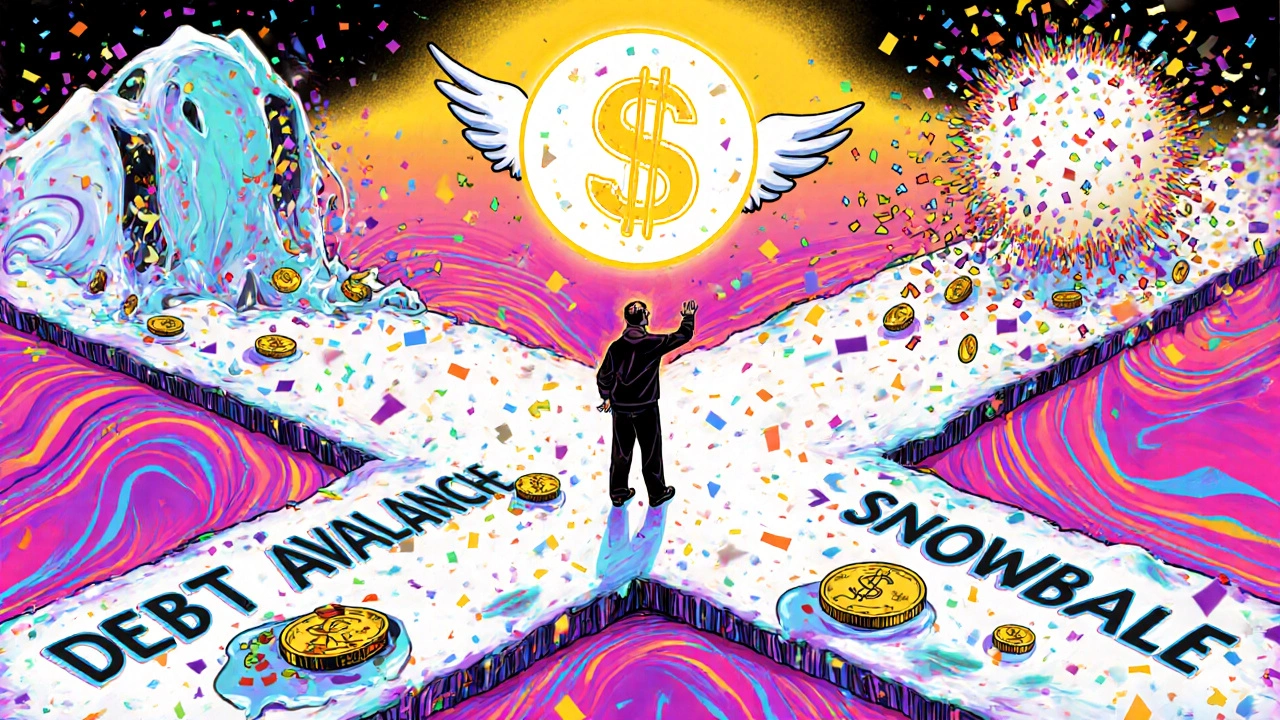
The Debt Avalanche vs. Snowball: Which Works Better?
There are two popular ways to pay off debt: the avalanche method and the snowball method.
- Avalanche: Pay off the debt with the highest interest rate first. Saves the most money.
- Snowball: Pay off the smallest balance first. Gives quick wins and motivation.
The National Foundation for Credit Counseling found that the avalanche method saves 15-20% more in interest over time. But the snowball method has a 28% higher completion rate-especially for people with multiple debts.
Here’s the truth: Behavior matters more than math. If you’re more likely to stick with a plan that gives you early wins, start with the snowball. Once you’ve paid off one debt, you’ll feel momentum. Then switch to avalanche for the rest.
Either way, you’re winning. Just pick the one that keeps you going.
Build Your Emergency Fund First-Yes, Really
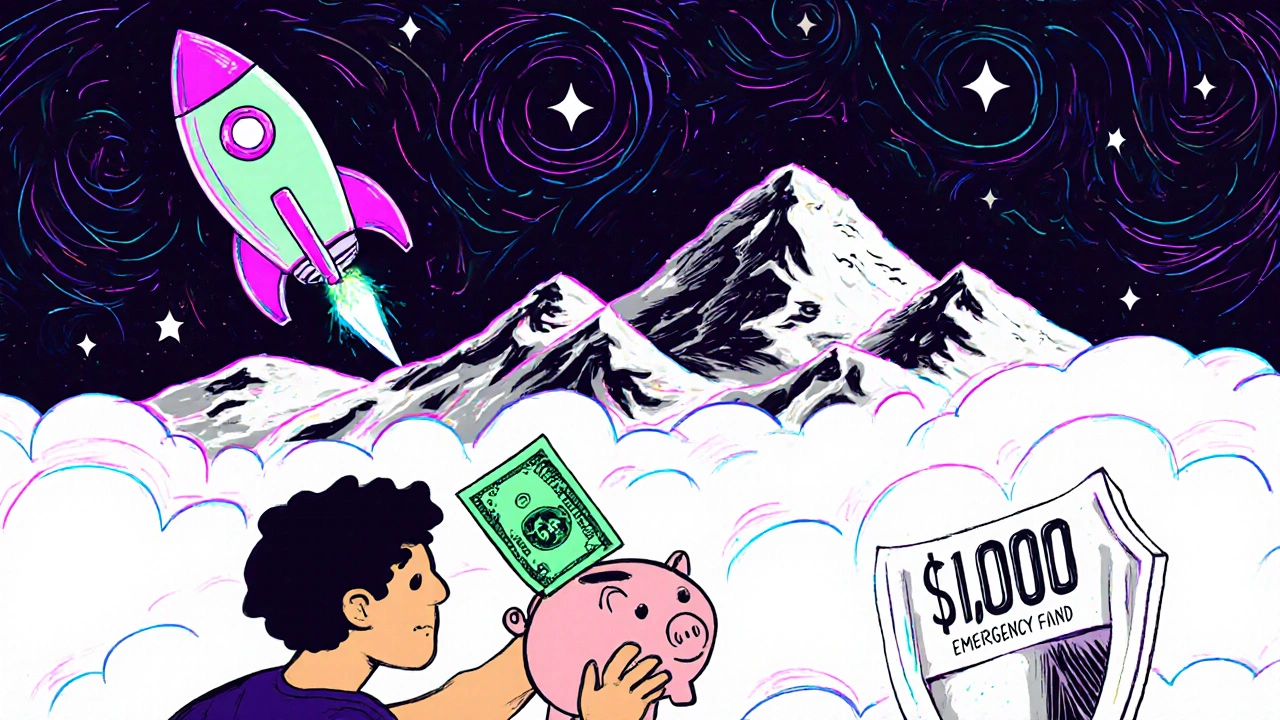
Before you even think about investing or aggressively paying down debt, build a small emergency fund. Not $10,000. Not even $5,000. Just $1,000.
Why? Because life happens. A flat tire. A broken appliance. A missed shift at work. If you don’t have cash set aside, you’ll use your credit card to cover it-and undo all your progress.
Once that $1,000 is in place, focus on high-interest debt. Then, after that’s gone, build your full emergency fund: 3-6 months of living expenses. Most certified financial planners (92%, according to FPA’s 2023 survey) say this step is non-negotiable.
What About Taxes and Retirement Accounts?
Don’t forget tax-advantaged accounts. A Roth IRA lets your investments grow tax-free. A traditional 401(k) lowers your taxable income today. Both are powerful tools.
If you’re in a high tax bracket, prioritize your 401(k) after the match. If you expect to be in a lower bracket in retirement, a Roth IRA might be better. But don’t overthink it. Start with whatever’s easiest. Consistency beats perfection.
The SECURE 2.0 Act of 2022 made this even easier. You can now withdraw up to $1,000 a year from your retirement account for emergencies-without penalty. That’s a safety net built into your investing strategy.
Real People, Real Results
Reddit’s r/personalfinance has over 2 million members. Look at the top posts. One user paid off $45,000 in credit card debt. Their post says: “The mental relief is worth more than any market return I could have earned.”
Another user on r/investing started putting $300 a month into index funds at 25 while keeping 3.5% student loans. At 35, their portfolio hit $182,000. No drama. No panic. Just steady investing.
Both are right. Because their choices matched their situations.
What If You’re Not Sure?
Here’s a quick decision tree:
- Do you have any credit card or payday loan debt above 10%? → Pay it off first.
- Do you have a 401(k) match? → Contribute enough to get the full match.
- Do you have $1,000 saved for emergencies? → If not, build it.
- Do you have student loans or a mortgage under 6%? → Invest while paying minimums.
- Are you stressed out by debt? → Pay it down faster-even if it’s below 6%.
That’s it. No complex formulas. No financial jargon. Just clear steps.
Don’t Wait for Perfect
Many people delay starting because they think they need to choose perfectly. But the market won’t wait. Debt won’t wait. Your future self won’t wait.
Start with one step. Pay off one credit card. Contribute one percent to your 401(k). Save $50 this week.
Progress beats perfection. And in personal finance, momentum is everything.
Graeme C
October 30, 2025 AT 10:55The 6% rule is solid, but let’s not pretend it’s gospel. I paid off a 7.2% student loan while investing in VTI-because I had a 10% employer match and a 9-month emergency fund. The math says invest, but my gut says ‘get the hell out of debt.’ Turned out, paying it off faster gave me the mental bandwidth to double my contributions afterward. No regrets.
Also, the ‘$1,000 emergency fund’ advice? Cute. Try living in London on minimum wage and surviving a broken boiler with only a grand. That’s not an emergency fund-that’s a Band-Aid on a hemorrhage. Aim for 3K minimum, or you’re just gambling with your credit score.
Astha Mishra
October 31, 2025 AT 04:34It is truly fascinating, this modern obsession with optimizing every dollar as if life were a spreadsheet. We speak of compound interest as if it were a deity, and debt as if it were sin-but what of the soul? The anxiety that clings to a credit card balance, the sleepless nights spent calculating APRs-these are not merely financial burdens, they are existential weights.
And yet, we are told to invest while paying minimums on a 3.5% loan, as if the market were a benevolent aunt who always sends birthday checks. But markets are not kind. They are indifferent. They do not care if you are tired, or lonely, or afraid.
Perhaps the real question is not whether to invest or pay off debt-but whether to live with the weight of uncertainty, or the quiet dignity of being debt-free. I choose dignity. Even if it means less money in the long run. Some things cannot be quantified in dollars and cents.
Kenny McMiller
November 1, 2025 AT 06:35Bro, the 6% rule is outdated AF. Inflation’s at 4.2%, real yields on Treasuries are negative, and the S&P is basically a casino with a 7% edge. If you’ve got a 4% student loan, you’re literally getting paid to carry it-especially with the tax deduction. And don’t even get me started on the 401(k) match. That’s free money, period. You’re leaving free money on the table if you don’t at least hit the match before crushing debt.
Also, emergency fund? $1k? That’s not an emergency fund, that’s a ‘I hope my Uber Eats credit card doesn’t decline’ fund. Go for 6 months of expenses. Or don’t. But if you’re not maxing your HSA, you’re doing it wrong.
Dave McPherson
November 1, 2025 AT 23:15Wow. Someone actually wrote an article that’s 80% common sense wrapped in jargon and a 2025 hook. Congrats, you just reinvented the wheel and called it a Tesla.
Let me guess-you also think ‘pay yourself first’ is a revolutionary concept? Newsflash: your ‘6% rule’ is just the old ‘interest rate comparison’ dressed up in a LinkedIn post. And the ‘$1,000 emergency fund’? That’s not advice, that’s a cry for help from someone who’s never been broke.
And don’t get me started on the snowball method. It’s for people who need dopamine hits to stay alive. If you’re the type who needs a ‘win’ to pay off debt, you probably shouldn’t be managing money at all. Just get a side hustle and stop reading financial blogs written by guys who think ‘APR’ is a new crypto token.
RAHUL KUSHWAHA
November 2, 2025 AT 00:48