
Fintech Loan Comparison Calculator
Your Business Profile
Your Results
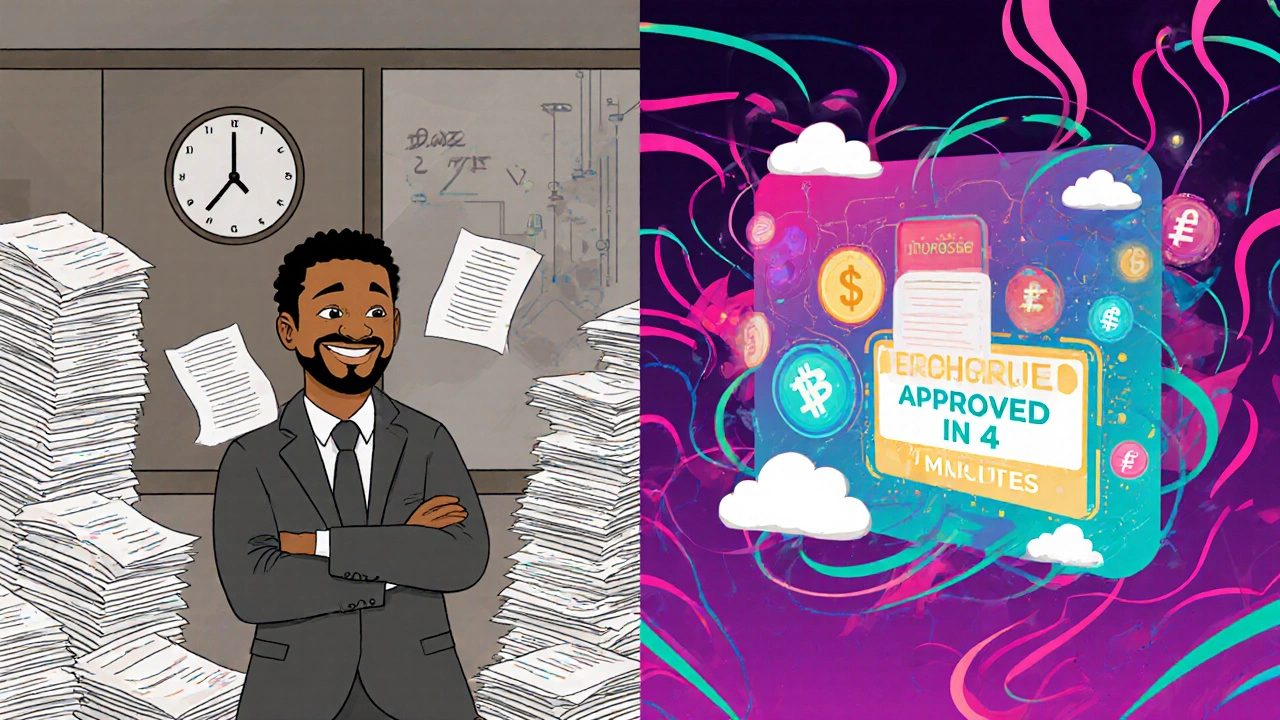
Imagine needing $20,000 to cover an unexpected repair for your business equipment. You walk into a bank with your paperwork, only to be told it’ll take three weeks to hear back. Meanwhile, your operations are on hold. Now imagine applying online, answering a few questions, and getting approved before you finish your coffee. That’s not science fiction-it’s what fintech lending delivers today.
What’s Changed in Loan Approval?
For decades, getting a business loan meant stacks of paper, in-person visits, and waiting. Traditional banks relied on FICO scores, tax returns, and manual underwriting. Approval could take 10 to 45 business days. If you missed a document? Start over. If your credit score was 680? You were likely denied. Fintech lenders flipped that model. They didn’t just make the process faster-they rebuilt it from the ground up. Using cloud systems, AI, and real-time data, they now make lending decisions in minutes or hours. Some platforms approve loans in under 60 seconds. By 2025, Deloitte predicts 90% of small business loans will be processed entirely digitally. That’s not a trend-it’s the new standard.How Fintech Makes Loans So Fast
Fintech lenders don’t just digitize old forms. They replace them with smarter systems. Here’s how it works:- Automated application processing: You fill out one form. The system pulls your bank statements, tax records, and sales data directly from your accounting software (like QuickBooks or Xero) with your permission.
- Alternative data scoring: Instead of relying only on your credit score, the algorithm looks at your business’s cash flow, payment history with suppliers, online sales volume, and even how often you update your website.
- AI-driven underwriting: Machine learning models analyze thousands of data points to predict risk. A business with steady monthly deposits and low debt is flagged as low-risk-even if their personal credit score isn’t perfect.
- Instant prequalification: Many platforms let you see if you qualify without affecting your credit score. You get a range of loan amounts and rates before you even submit a full application.
- Same-day funding: Once approved, money hits your account via ACH transfer-often within hours. Some lenders even offer funding by midnight on the same day you apply.
This isn’t magic. It’s technology working together. APIs connect your bank account to the lender’s system. Cloud servers process data in real time. Algorithms update continuously based on new data. The entire system runs without human intervention for most applications.
Who Benefits the Most?
Fintech lending doesn’t help everyone equally-but it’s a game-changer for specific groups:- Small business owners: 68% of fintech loan applicants have fewer than 20 employees. These are the people who can’t wait weeks for cash to cover payroll or inventory.
- Businesses with imperfect credit: If your personal credit score is below 700, traditional lenders often say no. Fintech lenders look at your business performance instead. A bakery with strong monthly sales but a 660 credit score might still qualify.
- Those needing urgent cash: A broken HVAC system. A delayed client payment. A last-minute bulk order. Fintech loans are built for these moments. Users on Reddit and Trustpilot regularly share stories like: “BlueVine approved $50K in 3 hours when my bank said 2 weeks.”
- Non-traditional businesses: Freelancers, e-commerce stores, and service-based businesses without physical assets often get turned down by banks. Fintech lenders see their revenue streams as collateral.
Fintech vs. Traditional Banks: A Real Comparison
| Feature | Fintech Lender | Traditional Bank |
|---|---|---|
| Approval Time | Minutes to hours | 10-45 business days |
| Documentation Required | Digital bank statements, tax IDs, online sales data | Physical tax returns, balance sheets, personal guarantees |
| Decision Criteria | Business cash flow, sales trends, alternative data | Personal credit score, collateral, years in business |
| Funding Speed | Same day to 24 hours | 5-10 business days after approval |
| Max Loan Amount | $500,000 (typically under $100,000) | $1M+ (common for commercial loans) |
| Interest Rates | Higher for lower credit scores (10%-30%) | Lower for strong applicants (4%-8%) |
Fintech wins on speed and accessibility. Banks still win on cost and scale. If you need $500,000 for a new location, a bank is still your best bet. But if you need $25,000 in 48 hours to fulfill a big order? Fintech is the only option.
What Data Do Fintech Lenders Actually Use?
Forget the myth that fintech lenders only care about your credit score. They look at what your business actually does:- Bank transaction history: Are deposits consistent? Do they cover expenses?
- Online sales data: Are you growing on Shopify, Amazon, or Etsy?
- Payment patterns: Do you pay suppliers on time? Do you have late fees?
- Business licenses and registrations: Is your business legally active?
- Accounting software sync: QuickBooks, Xero, or Wave data gives real-time profit and loss views.
- Industry benchmarks: Is your revenue in line with similar businesses in your region?
Some platforms even analyze your website traffic or social media engagement-though this is rare and always optional. The goal isn’t to invade privacy. It’s to build a fuller picture of your business health. A restaurant with 150 daily online orders and steady weekly deposits is a safer bet than one with a perfect credit score but declining sales.
What You Need to Do Before Applying
Speed means nothing if you’re rejected because you didn’t prepare. Here’s what to do before clicking “Apply”:- Check your business credit score. Use Dun & Bradstreet or Experian Business. Aim for 75+ (on a 100-point scale) for the best rates.
- Organize digital documents. Have ready: your EIN, recent bank statements (last 3-6 months), tax returns (last 1-2 years), and proof of business registration.
- Link your accounting software. If you use QuickBooks, connect it to the lender’s platform. It cuts approval time by half.
- Compare lenders. Not all fintech lenders are equal. Kabbage offers instant prequalification. OnDeck has 24/7 support. BlueVine is best for invoice financing.
- Apply for pre-approved offers. Many platforms let you see offers without a hard credit pull. These are pre-screened-you’re already halfway approved.
Most applications take under 15 minutes. The fastest ones ask for nothing more than your business name, email, and bank login credentials (securely encrypted). You’ll know if you qualify before you even finish typing.
Downsides and Risks
Fintech lending isn’t perfect. Here’s what to watch for:- Higher interest rates. If your credit is below 680, rates can hit 25%-30%. Compare APRs carefully.
- Short repayment terms. Many loans are due in 6-18 months. That means higher monthly payments.
- Automatic withdrawals. Most lenders require access to your bank account for repayment. If you’re low on cash, you risk overdraft fees.
- Technical glitches. Document uploads sometimes fail. Customer support isn’t always available after hours.
- Bias in algorithms. Harvard Business School researchers warn that AI models can unintentionally penalize businesses in low-income areas or minority-owned businesses if trained on biased historical data.
Know the fine print. Read the repayment schedule. Ask if there’s a prepayment penalty. And never apply to more than two lenders at once-multiple hard credit checks can hurt your score.

What’s Next for Fintech Lending?
The market is exploding. In 2022, global fintech lending hit $140 billion. By 2027, it’s projected to reach $330 billion. That’s an 18.5% annual growth rate.Here’s what’s coming:
- Real-time decisions: By 2025, most loans will be approved the moment you hit submit.
- AI co-pilots: Lenders will offer chatbots that guide you through applications, suggest loan amounts, and even predict your repayment success.
- Integration with payroll: Platforms may offer loans tied to your payroll cycle-repayments automatically adjust based on your cash flow.
- Regulatory clarity: More states are creating rules for fintech lenders. This will reduce scams but may raise compliance costs.
Traditional banks are catching up, too. JPMorgan’s Finn and Bank of America’s Digital Wallet now offer fast small business loans. But they still lag in speed and flexibility. Fintech’s edge isn’t just technology-it’s design. It’s built for people who need money now, not next quarter.
Frequently Asked Questions
How fast can I get a loan from a fintech lender?
Many fintech lenders approve loans in under 10 minutes. Funding can happen within hours-some offer same-day deposits if you apply before 3 PM. The fastest platforms, like Kabbage and BlueVine, have users reporting funds in their accounts within 2-4 hours.
Do I need good credit to qualify?
Not necessarily. While a credit score above 700 gets you the best rates, many fintech lenders approve applicants with scores as low as 600 if your business shows steady cash flow. They look at your bank deposits, sales trends, and payment history instead of just your credit report.
What’s the maximum loan amount I can get?
Most fintech lenders offer loans up to $500,000, but the average is between $10,000 and $100,000. If you need more than $250,000, traditional banks or SBA loans are still more common. Fintech is best for smaller, urgent funding needs.
Are fintech loans safe?
Yes-if you use reputable lenders. Look for platforms that use 256-bit encryption, are FDIC-insured for deposit accounts, and are registered with state regulators. Avoid lenders that ask for upfront fees or don’t disclose APRs. Stick to well-known names like OnDeck, Funding Circle, or BlueVine.
Can I get a loan if I’m a new business?
Some fintech lenders approve businesses under one year old, especially if you have strong personal credit and a clear business plan. Others require at least 6-12 months in operation. Check each lender’s minimum requirements before applying.
Next Steps
If you’re considering a fintech loan:- Start with prequalification on 2-3 platforms. No credit check needed.
- Compare APRs, repayment terms, and funding speed-not just the loan amount.
- Read reviews from real users on Trustpilot and Reddit. Look for patterns in complaints.
- Have your documents ready. You’ll save hours if you’re prepared.
- Apply during business hours. Support teams respond faster when they’re online.
Fintech didn’t just make loans faster. It made them fairer-for businesses that were once ignored. If you’ve been turned down by banks, or tired of waiting, this is your moment. The money isn’t hiding in a back office. It’s waiting for you to click ‘Apply’.
Laura W
October 31, 2025 AT 12:41OMG YES. I used BlueVine last month when my printer died mid-campaign and I needed $35K stat. Approved in 8 minutes, funds hit by 3 PM. No one asked for my personal tax returns. Just linked QuickBooks and boom-money. Banks are still stuck in the dial-up era.
Also, the fact they use sales trends instead of just FICO? That’s revolutionary. My credit score’s trash but my Shopify store’s crushing it. Finally, someone gets it.
Graeme C
October 31, 2025 AT 23:00This is not merely ‘faster’-it is a systemic dismantling of archaic financial gatekeeping. The reliance on alternative data-cash flow, supplier payment latency, even website update frequency-is not just innovative; it is epistemologically profound. You are no longer judged by your credit score, a static, reductive metric forged in the 1980s, but by the dynamic, living pulse of your enterprise.
Furthermore, the integration of APIs with accounting software constitutes a paradigm shift in risk assessment: real-time, granular, and non-invasive. Traditional banks cling to paper trails like medieval scribes clinging to parchment. They are not just slow-they are obsolete. The 90% digital projection by 2025 is conservative.
Astha Mishra
November 2, 2025 AT 20:12It’s fascinating how technology has become the great equalizer in finance, isn’t it? I come from a small town in India where small shop owners used to beg for loans from local moneylenders at 40% interest just to restock their inventory. Now, with platforms like LendingClub and Kiva expanding globally, even a chai stall owner with a Google Pay transaction history can get funded in hours.
But I wonder-does this algorithmic fairness truly exist? Or are we just replacing human bias with machine bias? If the AI was trained mostly on urban, tech-savvy businesses, what happens to the rural tailor who doesn’t use QuickBooks but has 20 years of handwritten ledgers? Is her business less ‘real’ because her data isn’t digital?
Also, I’ve heard stories of people getting denied because their website didn’t update often enough. That’s not assessing business health-that’s assessing digital presence. We must be careful not to confuse visibility with viability.
Still… I’m hopeful. Maybe this is the first time in history where a woman running a home-based embroidery business in Rajasthan has a fighting chance against a Wall Street bank’s spreadsheet. That alone is worth the risk.
Kenny McMiller
November 4, 2025 AT 10:29Let’s be real-fintech isn’t magic, it’s just better data engineering. The real win here is the API stack. You’re pulling transactional data directly from bank feeds via Plaid or Yodlee, feeding it into ML models trained on millions of small biz cash flows. No more guessing if someone’s ‘creditworthy’-you’re seeing actual behavior.
And yeah, the 60-second approvals? That’s because 80% of applications are auto-rejected. The system filters out the high-risk ones instantly, then the human underwriters only touch the borderline cases. So it’s not ‘fast,’ it’s ‘selectively fast.’
Also, if you’re a new biz with no history? Good luck. The algorithms still prefer 12+ months of data. So ‘accessible’ doesn’t mean ‘for everyone.’ Just for those who’ve been playing the game long enough to leave digital breadcrumbs.
Dave McPherson
November 4, 2025 AT 20:18Wow. What a beautifully engineered trap. You’re not getting a loan-you’re getting a debt trap wrapped in a UX designed by a Stanford dropout who thinks ‘speed’ equals ‘ethics.’
25% APR? Same-day funding? Automatic bank withdrawals? That’s not innovation-that’s predatory lending with a sleek website. You think you’re being ‘fair’ because you don’t care about FICO? Nah. You just don’t care about your borrowers’ survival.
And don’t even get me started on ‘alternative data.’ Now they’re spying on your Shopify sales and website traffic like it’s some kind of credit karma. Next thing you know, they’ll penalize you for not posting on Instagram enough.
Meanwhile, banks still offer 6% loans to people who actually have collateral. But no, we’re supposed to cheer because some algorithm gave me $10K in 4 minutes? Bro, that’s not empowerment-that’s financial crack. You get the hit fast, then you’re chained to 18-month payments while your business bleeds out.
Also, ‘prequalification’? That’s just a sugar-coated bait-and-switch. You think you’re safe until you see the fine print: ‘APR up to 30%.’ Yeah, real fair.
Next time you see a fintech ad, ask yourself: Who’s getting rich here? The borrower? Or the VC-funded startup that sold your cash flow as a security?