
Employee Wellness ROI Calculator
Calculate Your Wellness ROI
Enter your company's data to estimate how wellness programs could impact your bottom line through reduced turnover and improved productivity.
Input Your Company Data
Program Impact Estimates
Your Estimated ROI
ROI Estimate
Enter your data to see results
Based on SHRM's turnover cost calculations (50% for hourly, 150% for managers, 400% for executives) and presenteeism research showing 20% productivity loss from untreated health conditions.
When you spend money on employee wellness programs, you don’t just want to feel good about it-you need to prove it’s worth the investment. That’s where EWA ROI calculators come in. These aren’t fancy spreadsheets or guesswork tools. They’re precise systems used by HR and finance teams to turn things like lower turnover and higher productivity into dollar amounts. And if you’re not measuring them, you’re leaving real savings on the table.
Why Retention and Productivity Matter More Than Health Claims
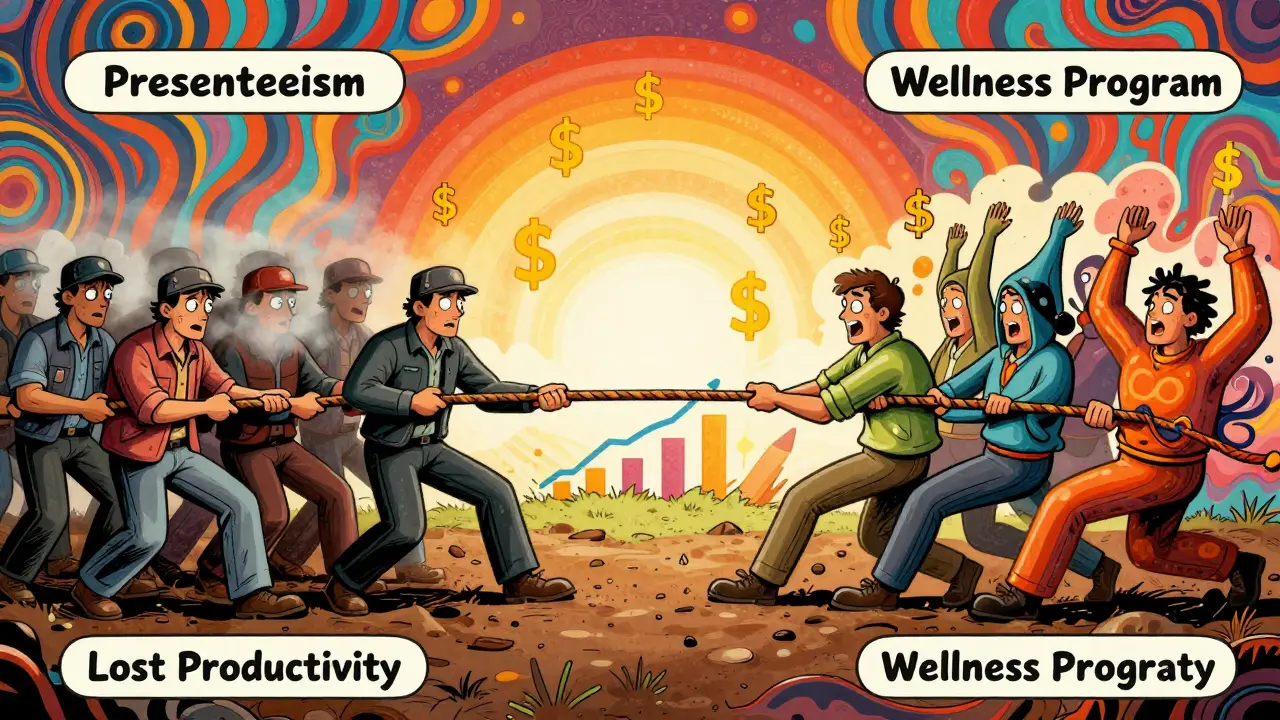
For years, companies measured wellness program success by looking at healthcare cost reductions. Lower doctor visits? Great. Fewer prescriptions? Even better. But here’s the problem: healthcare savings alone don’t tell the full story. A 2022 study from the University of Michigan found that calculators focusing only on medical costs underestimated total ROI by 62%. Why? Because the real money is in keeping people around and helping them show up fully engaged. Think about it. Replacing a mid-level employee costs, on average, 150% of their annual salary. For someone making $70,000, that’s over $100,000 in recruitment, onboarding, training, and lost output. Now imagine you cut turnover by just 5% across a 1,000-person company. SHRM estimates that saves $1.2 million a year. That’s not a wellness perk. That’s a profit line item. Productivity matters too. Presenteeism-when employees are at work but not fully functioning due to stress, fatigue, or chronic conditions-costs employers more than absenteeism. Stanford research shows that workers with untreated mental or physical health issues can lose up to 20% of their productive time. Wellness programs that reduce presenteeism don’t just make people feel better. They directly boost output.How the Top ROI Calculators Work
Not all EWA ROI calculators are built the same. Three major players dominate the space: WellSteps, Wellable, and A Step Ahead Challenge. Each uses different methods to measure retention and productivity, and understanding their differences can help you pick the right one. WellSteps focuses heavily on healthcare cost trends. You plug in your last 12 months of claims data, employee count, and average cost changes over five years. It then estimates savings based on health risk reduction. Their 2023 client data shows an average ROI of 3.27:1-but only if you ignore turnover. Their newer Presenteeism ROI Calculator, launched in September 2024, adds productivity metrics using the Stanford Presenteeism Scale. Early users report 4.7% average productivity gains, which translates to real revenue lift. Wellable’s calculator is the most comprehensive for retention. It uses SHRM’s official turnover cost formulas: 50% of salary for hourly workers, 150% for managers, and 400% for executives. It also tracks tenure changes tied to program participation. Their July 2024 update (Version 3.2) showed employees who engaged with wellness programs stayed 11.3 months longer on average. That’s not a soft metric-it’s a direct reduction in replacement costs. Their ROI calculator also factors in presenteeism, absenteeism, and even engagement survey scores. Users on G2 Crowd rate it 4.3/5, mostly because it forces you to confront hard numbers, not just feel-good stats. A Step Ahead takes a different approach. Their model is built around physical activity. They use a $606 annual financial risk per inactive employee, based on peer-reviewed research in the Journal of Occupational and Environmental Medicine. If 75% of participants become active, the savings add up fast. Their calculator is bundled with a walking challenge program priced at $19.95 per participant. It’s simple, focused, and works great for companies running step-based initiatives-but it doesn’t capture mental health or nutrition components.What Data You Actually Need to Run the Numbers
You can’t calculate ROI without data. And most companies struggle with this part. Here’s what each tool requires:- WellSteps: Total healthcare costs (past 12 months), number of employees enrolled, average % change in healthcare costs (last 5 years), optional inputs like obesity rate (U.S. average: 42.4%) and tobacco use (12.5%).
- Wellable: Turnover rates by department, average salary by job level, productivity metrics (sales per employee, units produced per hour), participation rates, and survey data on presenteeism.
- A Step Ahead: Number of participants, baseline activity level (inactive vs. active), and program completion rate.
Real Results: What Companies Are Actually Saving
Theory is one thing. Real results are another. A 500-person tech company in Austin used Wellable’s calculator to track their wellness program. After 18 months, they saw:- Turnover dropped 10%
- Average employee tenure increased by 14 months
- Presenteeism scores improved by 19%
The Hidden Flaws and Expert Warnings
No calculator is perfect. And experts aren’t shy about pointing out the weaknesses. Professor Al Lewis from the Disease Management Purchasing Consortium says many tools inflate productivity gains by 30-40% because they rely on flawed presenteeism surveys. The Stanford scale is validated, but many vendors use cheap, untested versions. If your calculator asks employees to rate their focus on a scale of 1-5, it’s probably not reliable. Harvard Business Review notes a 15-20% margin of error in all current ROI models. Why? Because you can’t perfectly isolate wellness from everything else happening in the company. A new manager, a pay raise, or a better benefits package could be the real reason turnover dropped. That’s why the Wellness Council of America introduced a new standard in October 2024: any ROI claim must include a 12-month minimum participation period and a control group comparison. No more “we ran a program and turnover went down”-you need to prove the program caused it.
How to Get Started
You don’t need a big budget or a team of analysts. Here’s how to begin:- Choose a calculator: If retention is your goal, pick Wellable. If you’re focused on physical activity, go with A Step Ahead. If you’re already tracking healthcare costs, start with WellSteps.
- Collect basic data: Pull turnover rates, average salaries by role, and participation numbers from your HRIS (Workday, ADP, SAP).
- Run a pilot: Start with one department. Track participation for six months. Then compare turnover and productivity before and after.
- Involve finance: Don’t present this as an HR project. Frame it as a cost-saving initiative. Show them the turnover cost formula. Make them see the numbers.
- Iterate: If the results are strong, expand. If not, tweak the program. Maybe it’s not the wellness plan-it’s the communication, or the incentives.
The Future Is Predictive
By 2026, Gartner predicts 80% of enterprise wellness programs will use ROI calculators measuring at least five outcomes-including retention and productivity. The next wave is AI-driven. Wellable’s 2025 roadmap includes predictive analytics that flag employees at risk of leaving based on wellness engagement patterns. Microsoft is planning to integrate wellness ROI data directly into Workplace Analytics by 2026. The message is clear: if you’re not measuring retention and productivity, you’re not measuring ROI. You’re guessing. And in today’s talent market, guessing is expensive.Can EWA ROI calculators really prove that wellness programs reduce turnover?
Yes, but only if they’re designed to measure it. Calculators like Wellable’s use SHRM’s official turnover cost formulas and track tenure changes tied to program participation. Companies using these tools have documented 8-12% reductions in turnover after 12-18 months. The key is linking participation to retention data-not assuming a correlation.
What’s the minimum ROI I should expect from a wellness program?
There’s no universal minimum, but Rand Corporation’s meta-analysis of 28 studies found an average ROI of $1.50 for every $1 spent when only healthcare costs are considered. When retention and productivity are included, that jumps to $3.27:1. Programs that measure both typically report ROI between 2:1 and 4:1. If your calculator shows less than 1.5:1, you’re probably missing key metrics like turnover cost.
Are free ROI calculators reliable?
Some are. Wellable and WellSteps offer free calculators, but they’re designed to lead you toward paid programs. The math itself is sound, based on peer-reviewed research. But free tools often lack the ability to import your real data or compare against control groups. For accurate results, you need to input your own turnover rates, salaries, and participation data-not just industry averages.
How long does it take to see ROI from a wellness program?
Turnover and productivity changes take time. Most calculators require at least 12 months of data to show statistically significant results. Some early wins-like reduced absenteeism-may appear in 6 months, but real retention savings usually take 18-24 months. Don’t expect quick fixes. This is a long-term investment in human capital.
Do I need HR software to use an ROI calculator?
You don’t need fancy software, but you do need data. Most calculators work with basic HRIS platforms like Workday, ADP, or SAP. If you’re using spreadsheets, you can still input numbers manually. The challenge isn’t the tool-it’s getting the right data from finance and HR. Start with what you have: turnover rates, average salaries, and participation numbers. You don’t need perfect data to begin-you need to start measuring.
Can wellness programs improve productivity without reducing healthcare costs?
Absolutely. Productivity gains come from reducing presenteeism-when employees are at work but mentally or physically drained. Mental health support, flexible schedules, and stress management programs can boost output without lowering medical claims. Wellable’s calculator tracks this using the Stanford Presenteeism Scale. One company saw a 19% productivity lift from a mindfulness program, even though their healthcare costs stayed flat.
Royce Demolition
January 8, 2026 AT 07:50Bro. I just ran the Wellable calculator on our team and holy shit-we saved $420k in one year just from turnover drop. 🤯 No more begging finance for budget, now they’re asking *us* what’s next. Seriously, if you’re not measuring retention, you’re just throwing money into a void. 🚀 #WellnessIsNotAPerksPage
Sabrina de Freitas Rosa
January 10, 2026 AT 07:34Ugh. I’ve seen this crap before. ‘Wellness program saved us millions!’ Yeah, right. Your turnover dropped because HR finally stopped being jerks and gave people flex hours. Not because someone did 10k steps a day. 🙄 You’re all just using fancy math to cover up bad management. And don’t get me started on those ‘Stanford scales’-half the companies use a Google Form with a 1-5 slider. That’s not science, that’s wishful thinking. 🤦♀️
Erika French Jade Ross
January 10, 2026 AT 10:05honestly? i think sabrina has a point… but also? the data’s still real. my buddy’s company used the a step ahead challenge and their absenteeism dropped by 30% in 8 months. didn’t need fancy software-just a slack bot that pings people to walk. 🌿 maybe the tools aren’t perfect, but if they get people moving, talking, or staying… that’s win enough. also, typo: ‘turnvoer’ 😅