
Portfolio Rebalancing Calculator
Rebalance Your Portfolio
Ever check your portfolio and feel like it’s acting like a different person than when you set it up? You planned for 60% stocks, 40% bonds. But now, stocks are 72% of your holdings. That’s not a mistake. That’s portfolio drift.
Portfolio drift doesn’t happen because you made a bad decision. It happens because markets move. When one asset class outperforms others - like stocks surging during a bull market - your original balance slips away. Your carefully chosen risk level starts to change without you doing a thing. And that’s dangerous.
Here’s the truth: if you don’t fix drift, you’re not investing. You’re gambling.
Why Your Portfolio Drifts Without You Doing Anything
Imagine you put $60,000 in stocks and $40,000 in bonds to make a 60/40 portfolio. A year later, stocks jump 20%. Your stock portion is now $72,000. Bonds barely moved - still $40,000. Total portfolio? $112,000. Now your allocation is 64% stocks, 36% bonds. You didn’t buy more stocks. You didn’t sell bonds. The market did it for you.
That’s drift. And it’s silent. It creeps up while you’re focused on your job, your kids, your vacation. No alarm sounds. No email warns you. But your risk profile changed. A 60/40 portfolio drifting to 70/30 isn’t just a tweak. It’s a 23% increase in potential downside during a market crash, according to Vanguard’s historical analysis.
Drift doesn’t care if you’re managing $50,000 or $5 million. Even small portfolios can swing 8-12 percentage points in just 18 months during strong markets. BlackRock tracked a 60/40 portfolio that swung from 55/45 to 65/35 in six months during the 2020 pandemic rollercoaster. That’s not a fluke. That’s normal.
What Happens When You Ignore It
Ignoring drift means you’re letting the market dictate your risk - not you.
Take the case of an investor who stuck with a 60/40 portfolio from 2019 to 2021. Stocks soared. By early 2021, their portfolio was 78% stocks. Then came 2022. The market dropped 20%. That investor lost 22% more than they would have if they’d rebalanced back to 60/40. Why? Because they were overexposed to the asset that got crushed.
It’s not just about losing more. It’s about losing control. Your original goal was steady growth with moderate risk. Now you’re riding a stock-heavy rocket with no seatbelt. That’s not investing. That’s hoping.
And here’s the kicker: the longer you wait, the worse it gets. A never-rebalanced 60/40 portfolio can drift to 80% stocks over 10-15 years. That’s not a diversified portfolio anymore. That’s a single-asset bet with bonds as an afterthought.
How Much Drift Is Too Much?
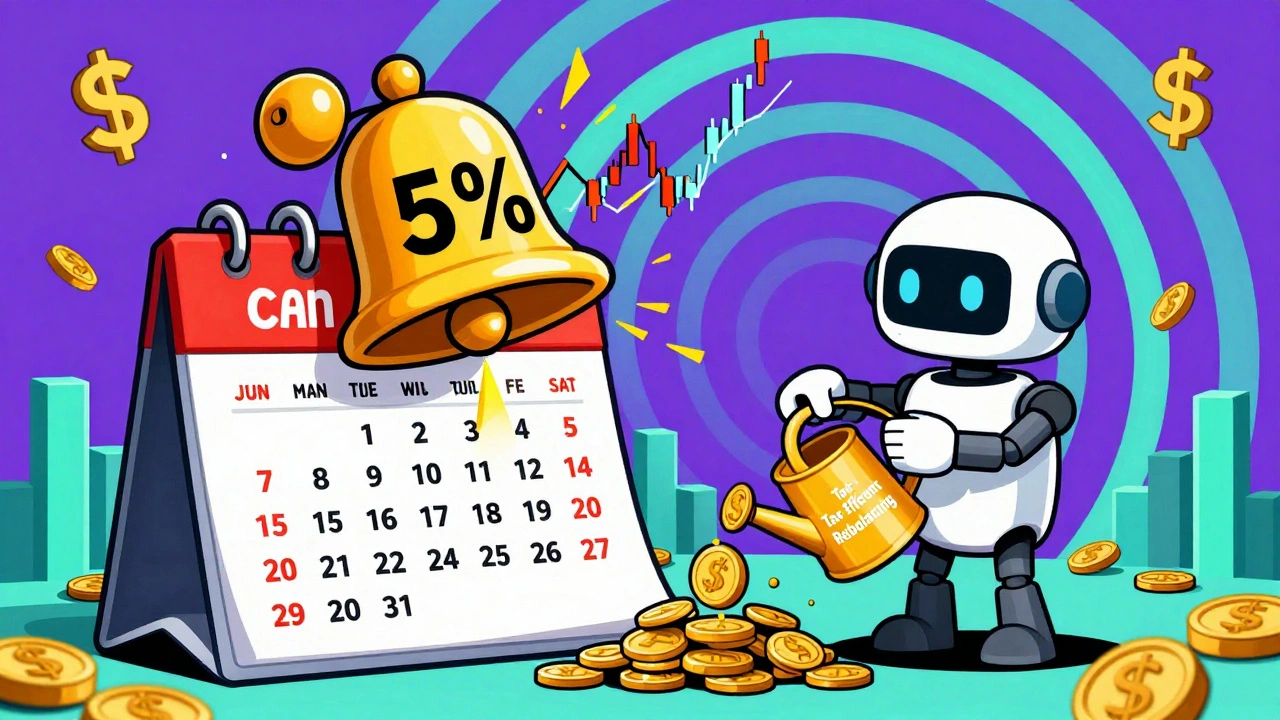
There’s no universal rule, but most pros use a 5% threshold. If any asset class moves more than 5 percentage points from its target, it’s time to act.
Why 5%? Because that’s where risk starts to change meaningfully. A 60/40 portfolio drifting to 65/35 isn’t just a 5% shift on paper. It’s a measurable increase in volatility. Fidelity’s analysis of 1.2 million accounts showed portfolios drifting beyond 10% from target underperformed by 0.68% annually over 15 years. That’s not a tiny difference. That’s $680 lost per $100,000 every year.
Some experts, like Dr. Craig Israelsen, argue that 10% drift is fine. But the data doesn’t back that up. The majority of research - from Vanguard, BlackRock, and Dimensional Fund Advisors - shows that portfolios kept within 5% of target had 18% lower maximum drawdowns during market crashes.
Think of it like driving. You don’t wait until you’re in the ditch to correct your steering. You nudge the wheel when you start drifting toward the edge.
How to Rebalance: The Three Main Ways
There are three ways to bring your portfolio back on track. Each has pros and cons.
1. Threshold-Based Rebalancing (The Smart Way)
This is what 56% of professional advisors use. You set a trigger - usually 5% - and when any asset class crosses it, you rebalance.
Example: Your target is 60% stocks. When it hits 65%, you sell 5% of your stocks and buy bonds to bring it back to 60%. Simple. Effective.
Pros: Keeps risk tight. Outperforms calendar-based rebalancing by 0.37% annually over 20 years, according to the Journal of Financial Planning.
Cons: Requires monitoring. If you’re doing it yourself, you’ll need to check your portfolio every few months. Tools like Personal Capital, YCharts, or your brokerage’s allocation tracker can automate the alerts.
2. Calendar-Based Rebalancing (The Simple Way)
Rebalance once a year - or every quarter - no matter what. It’s easy. You set a date: January 1st. You check. You fix.
Pros: Low effort. Low transaction costs. Good for smaller portfolios under $100,000, where frequent trading eats into returns.
Cons: Lets drift grow. Vanguard found annual rebalancing still allows an average 6.2% drift between checks. That’s enough to change your risk profile.
3. Hybrid Approach (The Balanced Way)
Use both. Set a calendar (say, yearly), but if any asset class drifts more than 10% before then, rebalance early.
Pros: Best of both worlds. Less monitoring than pure threshold, but more control than pure calendar.
Cons: Slightly more complex. Requires judgment.
Rebalancing in Taxable Accounts: The Tax Trap
Here’s where things get messy.
If you’re rebalancing in a taxable account - not an IRA or 401(k) - selling stocks that have gone up means you owe capital gains tax. That’s real money. Morningstar estimates this costs investors 0.15% to 0.40% annually in extra taxes.
But there’s a way out.
Don’t sell. Buy new money. If your stocks are too high, don’t sell them. Instead, put new contributions into bonds or cash until the balance shifts back. Or use dividends and interest payments to buy underweight assets.
Robo-advisors like Betterment and Wealthfront do this automatically. Betterment’s Tax-Coordinated Portfolio feature saves 0.31% in taxes annually by using this method, according to their 2022 white paper. Wealthfront’s tax-loss harvesting does the same - selling losers to offset gains, then rebalancing.
If you’re doing it yourself, keep a log. Track your cost basis. Know what’s taxable. And don’t panic. A little tax is better than a lot of risk.
Who Shouldn’t Rebalance
Not everyone needs to. If your portfolio is dominated by one stock - say, 30% in Tesla - rebalancing won’t fix the real problem. You’re not dealing with drift. You’re dealing with concentration risk.
That 2020 Tesla investor who held 30% of their portfolio in one stock? Within nine months, that single stock ballooned to 42% of their holdings. Rebalancing would’ve helped - but only after they reduced the position. The real fix wasn’t rebalancing. It was cutting the single stock.
Same goes for people with tiny portfolios under $25,000 and no new contributions. Transaction costs might eat more than the benefit. But if you’re adding money regularly, even small accounts can rebalance using new cash.
Tools to Make It Easy
You don’t need to be a spreadsheet wizard. Here’s what works:
- Free trackers: Fidelity and Vanguard offer free portfolio allocation tools. Just log in, link your accounts, and it shows your current vs. target allocation.
- Automated alerts: BlackRock’s Aladdin Wealth sends alerts when drift hits 5%. Many brokerages now have this built in.
- Robo-advisors: Wealthfront, Betterment, and Schwab Intelligent Portfolios rebalance automatically - and handle taxes too.
- Spreadsheets: If you’re DIY, download a free template. Update it quarterly. It takes 15 minutes.
Most investors who start using these tools say they wish they’d done it sooner. Reddit users on r/personalfinance report that 82% of those using automated rebalancing say it’s a “set-and-forget” win.
The Bigger Picture: Why This Matters
Drift isn’t about math. It’s about discipline.
David Swensen, the legendary Yale CIO, called failure to rebalance “the single largest strategic error made by individual investors.” He wasn’t exaggerating. Your portfolio isn’t a set-it-and-forget-it machine. It’s a living system. It needs maintenance.
And it’s not just about returns. It’s about sleep. When your portfolio is in line with your risk tolerance, you don’t panic during crashes. You don’t sell at the bottom. You stay calm. You stick to the plan.
That’s the real value of rebalancing. Not the 0.4% extra return. Not the tax savings. It’s the peace of mind that comes from knowing your risk hasn’t secretly doubled while you weren’t looking.
The market doesn’t care what you planned. It moves. Your job isn’t to predict it. Your job is to control your exposure to it. And that starts with one simple habit: checking your allocations - and fixing them - before they fix you.
What’s Next
The industry is moving fast. AI tools like J.P. Morgan’s “Portfolio Guardrails” now predict drift before it happens. BlackRock is rolling out dynamic thresholds that adjust based on market volatility. By 2026, nearly 70% of advisory firms will use AI-driven drift management.
But you don’t need AI to start. You just need to act.
Right now, open your brokerage account. Check your allocation. Compare it to your target. If anything’s off by 5% or more, write down what you’ll do. Buy more of the underweight. Sell a little of the overweight. Or wait for your next paycheck and direct it where it’s needed.
Don’t wait for the next market crash to realize you’re overexposed. Do it now. Before the drift becomes a flood.
What causes portfolio drift?
Portfolio drift happens when different assets in your portfolio grow at different rates. For example, if stocks rise faster than bonds, your stock percentage increases even if you didn’t buy more. It’s not due to your actions - it’s due to market movements.
How often should I rebalance my portfolio?
Most investors should rebalance when any asset class drifts more than 5% from its target. You can do this annually, quarterly, or use automated alerts. For smaller portfolios under $100,000, annual rebalancing often makes more sense to avoid high trading costs.
Is rebalancing taxable?
Yes, if you’re rebalancing in a taxable account and you sell assets that have gained value, you may owe capital gains tax. To avoid this, use new contributions or dividends to buy underweight assets instead of selling winners. Robo-advisors like Betterment handle this automatically with tax-loss harvesting.
Can I ignore portfolio drift if I’m young?
No. Even young investors need to manage drift. While you can tolerate more risk, drifting too far into stocks means you’re exposed to bigger losses if the market drops. Rebalancing keeps your risk level aligned with your goals - not market luck.
Do I need special tools to rebalance?
No, but tools make it easier. Free platforms from Fidelity and Vanguard show your allocation. Robo-advisors like Wealthfront and Betterment rebalance automatically. If you’re DIY, a simple spreadsheet updated quarterly is enough to get started.
What if my portfolio is mostly one stock?
Rebalancing won’t fix this. If one stock makes up 25% or more of your portfolio, you’re not dealing with drift - you’re dealing with concentration risk. The real fix is reducing that single position and spreading your money across more assets.
Does rebalancing improve returns?
Not directly. Rebalancing doesn’t make you richer. But it helps you avoid bigger losses by keeping your risk level stable. Studies show portfolios kept within 5% of target have 18% lower maximum drawdowns during market crashes - which means you’re more likely to stay invested and benefit from long-term growth.
Graeme C
December 4, 2025 AT 22:10This article is absolutely spot-on - and I’m sick of hearing people say ‘just buy and hold’ like it’s some sacred mantra. Drift isn’t some abstract finance concept; it’s the silent killer of retirement dreams. I watched a buddy with a 60/40 portfolio in 2020 drift to 82% stocks by 2021. He swore he was ‘playing the market.’ Then 2022 hit. Lost 34%. He cried in a Starbucks. I didn’t judge him - I just handed him a spreadsheet and told him to check his allocation every quarter. He’s back on track now. Don’t be him.
Astha Mishra
December 6, 2025 AT 01:12There’s something profoundly human about how we treat our portfolios like static sculptures when markets are living, breathing organisms. We design them with intention - a 60/40 split, a vision of calm growth - and then we abandon them to the chaos of price movements as if silence equals safety. But drift doesn’t whisper; it screams in the language of compounding returns and hidden risk. I’ve come to see rebalancing not as a mechanical chore, but as an act of self-trust - a daily reaffirmation that we are not slaves to market euphoria or panic, but stewards of our own future. It’s not about maximizing returns. It’s about preserving agency. And in a world that constantly pulls us toward impulsivity, that’s the most radical act of financial wisdom there is.
Laura W
December 7, 2025 AT 09:17Y’all are overcomplicating this. If you’re using a robo-advisor, just let it do its thing. Betterment’s Tax-Coordinated Portfolio? It’s literally magic. I used to manually rebalance every year - spreadsheet, tax headaches, stress. Now? I fund my IRA, forget about it, and check in once a year. My allocation’s always on target. My taxes are optimized. My sleep schedule? Improved. Stop overthinking. Use tech. It’s 2025. You don’t need to be a CFO to manage your money. Just be smart enough to outsource the boring stuff.
Kenny McMiller
December 7, 2025 AT 15:45Look, if your portfolio is under $25k and you’re not adding new money, just chill. Rebalancing costs more in fees and tax friction than it gains you in alpha. I’ve seen guys on Reddit sweating over 3% drift in a $12k account - and they’re paying $15 a trade. That’s not investing. That’s financial OCD. If you’re contributing monthly, sure, use new cash to nudge things. But if you’re not? Let it ride. Your time’s worth more than the 0.2% you might ‘save.’