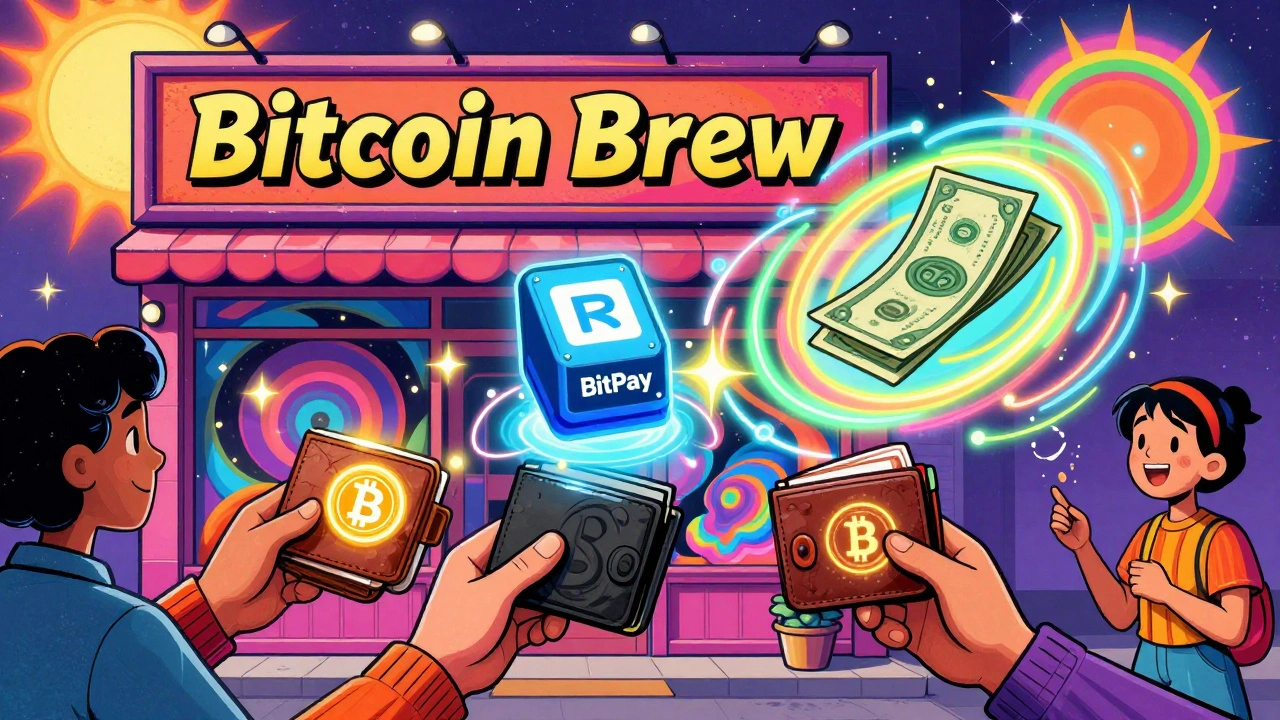
Bitcoin Payment Cost Calculator
Calculate Your Payment Costs
OpenNode: 0.3% fee, Lightning Network
BitPay: 1% fee, 12 currencies
Coinbase: 0.5% fee, no Lightning yet
Want to accept Bitcoin payments but don’t know where to start? You’re not alone. More businesses-from small coffee shops to big brands like Microsoft-are using Bitcoin to get paid. But it’s not just about adding a crypto button to your checkout. There’s real tech, real fees, and real choices behind how Bitcoin payments actually work. This isn’t theory. It’s what’s happening right now in 2025.
How Bitcoin Payments Actually Work
Accepting Bitcoin isn’t like swiping a credit card. When a customer pays with Bitcoin, their wallet sends the coins to your wallet. But here’s the catch: you don’t have to hold them. Most businesses use a payment processor-like BitPay, Coinbase Commerce, or Speed-to turn Bitcoin into cash automatically. These services act as middlemen. They receive the Bitcoin, confirm the transaction, and then send you USD, EUR, or another fiat currency. The whole thing takes seconds if they use the Lightning Network, or 10-60 minutes if it’s a regular Bitcoin transaction.
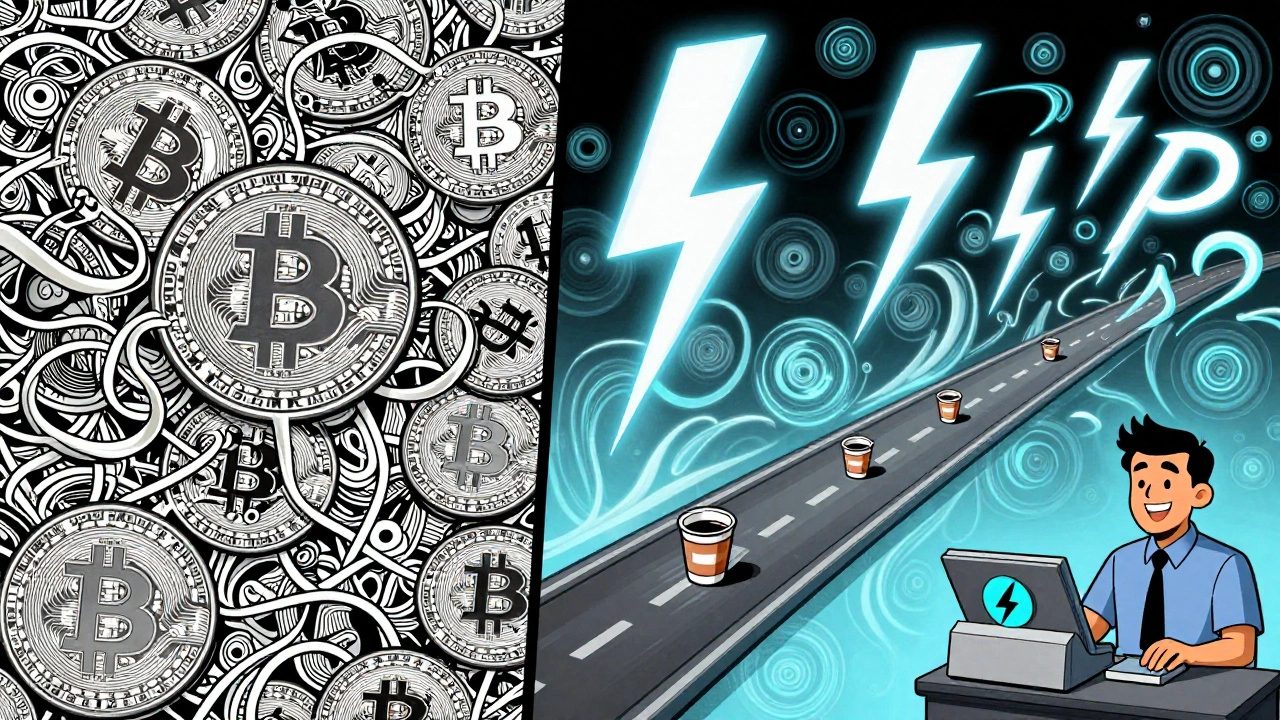
That’s the key difference: on-chain vs. Lightning. On-chain means the transaction goes directly on Bitcoin’s main blockchain. It’s secure but slower and pricier when the network is busy. Lightning Network is like a side highway. It lets you send payments almost instantly, for pennies. Speed and OpenNode built their whole business around this. For a $5 coffee, you’re paying $0.03 instead of $1.20. That’s why small businesses are switching fast.
Choosing the Right Payment Processor
Not all Bitcoin processors are the same. Here’s how the big players stack up in 2025:
- BitPay: Used by big names like AT&T and Microsoft. They convert Bitcoin to fiat in 12 currencies. Fees are 1%, but they offer chargeback protection and enterprise support. Problem? Their customer service takes over two days to respond on average.
- Coinbase Commerce: Great for developers. Their API is clean, reliable, and supports 15+ cryptocurrencies. But they don’t support Lightning Network yet, so Bitcoin payments take longer. Their uptime is 95%, but their fraud tools are basic.
- OpenNode: Best for low-cost, high-volume transactions. They charge just 0.3% and have a 99.8% success rate with Lightning. Only supports Bitcoin and Litecoin, though.
- Speed: The fastest-growing option. They let you convert Bitcoin to USDT or USDC instantly. Setup takes 15 minutes. No monthly fees. Their mPOS app turns any card reader into a crypto terminal. Merchants report cutting payment costs by 97%.
- Stripe: Not a crypto-native company, but they added Bitcoin support in 2024. Fees are low at 0.4%, but you need a dev team to set it up. Only for businesses with technical resources.
Most small businesses pick Speed or OpenNode. Big companies stick with BitPay for support and compliance. If you’re selling digital products or services globally, Speed’s multi-currency stablecoin swaps make sense. If you’re a developer building a SaaS product, Coinbase Commerce gives you the tools.
Costs and Fees You Can’t Ignore
Here’s the real math:
- Processor fees: 0.3% to 1%. Most charge 0.5-0.75%.
- Bitcoin network fees: $0.50-$5.00 per transaction. These spike during holidays or market rallies.
- Conversion fees: If you want USD, expect 0.95% on average. If you hold Bitcoin, it’s 0.5%.
- Lightning Network: Almost free. Under $0.01 for 95% of transactions.
Compare that to credit cards: 2.9% + $0.30 per transaction. Or PayPal: 3.5% for international sales. Bitcoin payments cut those costs by 70-90%. A Shopify store in Germany saved $4,200 in fees last year just by switching to OpenNode for Bitcoin payments on their €20-€50 products.
But watch out for hidden traps. Some processors charge $50/month if you don’t hit a minimum volume. Others lock you into 12-month contracts. Speed and OpenNode don’t. They’re pay-as-you-go. That’s why 68% of new Bitcoin users are small businesses, not enterprises.
Setting It Up: What You Actually Need to Do
You don’t need to be a coder. Here’s how to get started in under an hour:
- Choose your processor. Pick one based on your business size and tech skills. Speed is easiest for beginners.
- Sign up. You’ll need your business name, address, and ID. KYC takes 24-72 hours.
- Connect your wallet. Most processors give you a wallet. Or connect your own non-custodial wallet (like BlueWallet or Sparrow) if you want full control.
- Set your payout. Choose daily, weekly, or instant. Instant means you get USD the second a payment clears.
- Integrate. For websites: copy-paste a script. For physical stores: plug in Speed’s mPOS app to your existing card reader.
- Test. Send yourself a $1 Bitcoin payment. Watch it convert. Make sure it lands in your bank.
Most platforms have video guides. Speed’s setup walkthrough is 8 minutes long. BitPay’s is 22 minutes. You can be live by lunchtime.
What Can Go Wrong (And How to Avoid It)
It’s not all smooth sailing. Here are the top three issues merchants face:
- Address mismatch: Customers send Bitcoin to the wrong address. Happens in 8.3% of failed payments. Fix: Always show the exact address on-screen, not just a QR code. Enable dual verification so the customer must confirm the amount before sending.
- Network delays: During holiday sales or crypto rallies, Bitcoin transactions can take over 30 minutes. Fix: Use Lightning Network. It’s immune to congestion. OpenNode and Speed handle this automatically.
- Conversion rate swings: If your processor settles in 30 seconds, the price of Bitcoin might shift slightly. It’s usually under 0.5%. Fix: Choose a processor that locks the rate at the moment the customer pays-not when it clears.
One merchant in Toronto lost $1,200 because a customer sent Bitcoin to an old address they’d reused. They didn’t know Bitcoin addresses should be used once. Now they use Speed’s auto-generating addresses. No more mistakes.
Why Businesses Are Switching
It’s not just about saving money. It’s about access.
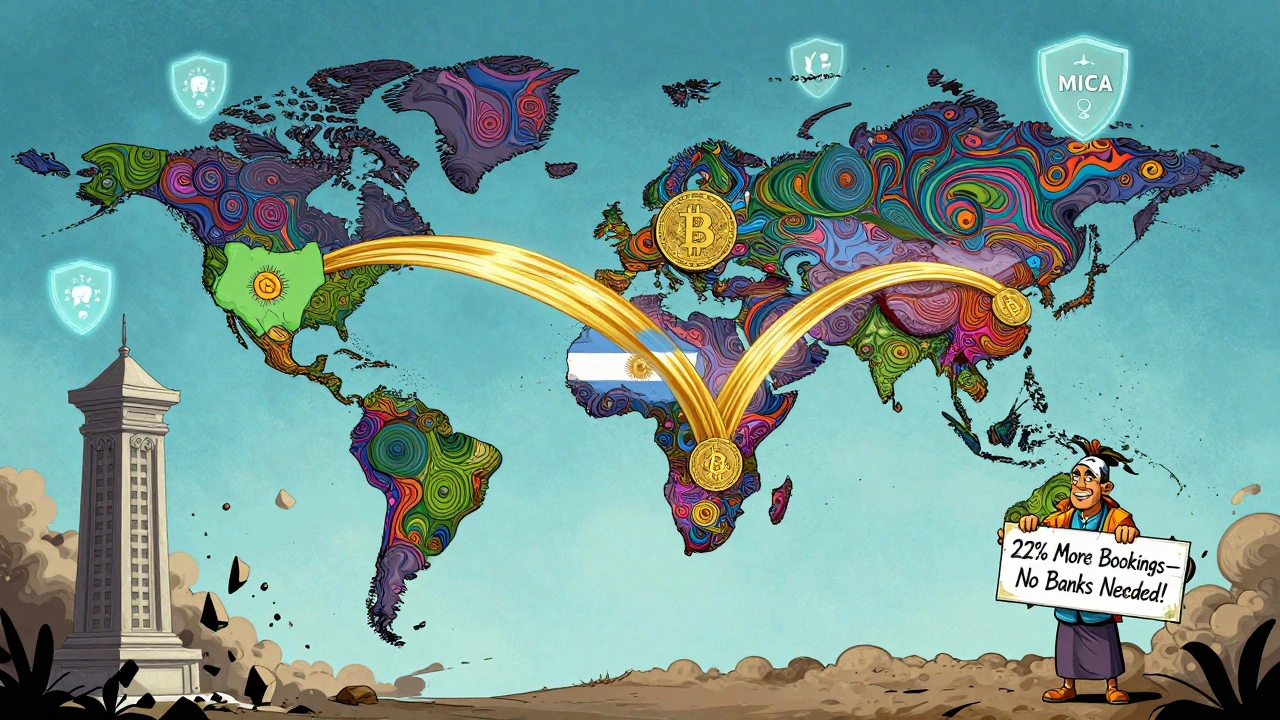
Think about a small business in Nigeria. They can’t get a PayPal account. Or a freelancer in Argentina. Their bank blocks international payments. Bitcoin lets them get paid from anywhere. In Europe, 38.7% of merchants now accept crypto. In North America, it’s 22.4%. But the growth is fastest in emerging markets.
And it’s not just for the unbanked. A boutique hotel in Bali started accepting Bitcoin and saw a 22% jump in bookings from crypto-savvy travelers. A digital marketing agency in Berlin stopped paying $200/month in wire fees and now gets paid instantly from clients in Japan, Brazil, and Canada.
Bitcoin isn’t just a currency. It’s a payment rail that bypasses banks, borders, and brokers.
What’s Next in 2026 and Beyond
The next two years will change everything.
Lightning Network will handle 65% of Bitcoin payments by 2026. That means faster, cheaper, and smoother transactions. New protocols like RGB will add privacy-so your customers’ payment history stays private. And AI fraud tools are coming. Gartner predicts they’ll cut false declines by 45% by 2027.
Regulations are catching up too. The EU’s MiCA rules now require processors to hold 1:1 reserves. The U.S. is rolling out the Travel Rule: any transaction over $3,000 needs identity info. That’s forcing processors to upgrade. BitPay just launched biometric approval for high-value payments.
But the biggest shift? Banks are starting to accept Bitcoin payments too. JPMorgan and HSBC are testing crypto settlement rails. That means one day, your Bitcoin payment might go straight into your bank account without a processor at all.
Final Thought: Is It Worth It?
If you’re selling anything online-or even in person-yes. The fees are lower. The customers are growing. The tech is simpler than ever.
Start small. Add Bitcoin as an option alongside PayPal and credit cards. See how many customers use it. Track the savings. You might be surprised.
Bitcoin payments aren’t about speculation. They’re about efficiency. About freedom. About giving your business a way to get paid that doesn’t depend on banks, borders, or middlemen. That’s not hype. That’s the reality in 2025.
Can I accept Bitcoin payments without a third-party processor?
Yes, but it’s risky. You can set up your own Bitcoin wallet and share the address. But you’ll need to manually confirm each transaction, handle chargebacks (which Bitcoin doesn’t have but customers might dispute), and deal with price swings. Most businesses use processors because they automate conversion to fiat, protect against fraud, and handle compliance. Unless you’re a crypto expert with time to manage it, use a processor.
How long does a Bitcoin payment take to confirm?
On the Bitcoin blockchain, it takes 10-60 minutes for one confirmation. For most payments, one confirmation is enough. But if you’re using the Lightning Network-through processors like Speed or OpenNode-it’s 2-5 seconds. Lightning is the future for everyday transactions.
Are Bitcoin payments reversible?
No. Bitcoin transactions are final. Once sent, they can’t be undone. This is why processors like BitPay offer chargeback protection-they cover you if a customer claims they didn’t authorize the payment. But if you accept Bitcoin directly, you’re on the hook. Always verify the amount and address before delivering goods or services.
Do I need to pay taxes on Bitcoin payments?
Yes. In most countries, Bitcoin payments are treated as property, not currency. That means you pay capital gains tax when you convert it to fiat or spend it. If you sell a product for $100 in Bitcoin and later convert it to USD when Bitcoin is worth $110, you owe tax on the $10 gain. Use accounting tools like Koinly or CoinTracker to track your crypto transactions.
What’s the minimum amount I can accept?
Most processors allow payments as low as $3-$5. Speed and OpenNode let you accept even smaller amounts via Lightning Network-down to $0.10. That’s perfect for digital downloads, tips, or coffee shop purchases.
Can I accept Bitcoin and get paid in stablecoins?
Yes. Speed, OpenNode, and Coinbase Commerce all let you settle in USDT or USDC. Stablecoins are pegged to the dollar, so you avoid Bitcoin’s price swings entirely. You still get the benefits of crypto payments-low fees, global access-but your balance stays stable. Many merchants prefer this option.
Is Bitcoin payment processing legal?
Yes, in most countries. The EU, Canada, Japan, and most of Latin America fully allow it. In the U.S., it’s legal but regulated differently by each state. You must comply with KYC rules and, as of November 2025, the Travel Rule for transactions over $3,000. Always check your local laws. Reputable processors handle compliance for you.
Geoffrey Trent
December 10, 2025 AT 00:43Look, I get it, Bitcoin’s ‘revolutionary’ and all, but let’s be real-most small businesses that take it end up with a wallet full of volatility and a headache from explaining to customers why their $5 coffee cost $5.20 yesterday and $4.80 today. And don’t even get me started on ‘Lightning Network’-sounds like a sci-fi movie title. I’d rather just swipe my damn card and be done with it.
John Weninger
December 11, 2025 AT 17:06I love how this post breaks it down without the usual crypto bro hype. Seriously, as someone running a tiny café in Melbourne, I was terrified of diving into crypto-but after switching to OpenNode, my international customers (looking at you, Japan and Germany) are finally paying on time, and my fees dropped from 3.5% to 0.3%. No more waiting days for wire transfers. It’s not magic, it’s just better infrastructure. If you’re on the fence, just try it with one product. You might be shocked how easy it is.
Omar Lopez
December 12, 2025 AT 00:46While the general tone of this article is serviceable, it exhibits a troubling lack of precision in its technical exposition. For instance, the assertion that Lightning Network transactions are ‘under $0.01 for 95% of transactions’ is statistically imprecise and misleading-fee structures are non-linear and depend on channel liquidity, routing hops, and time-lock parameters. Furthermore, the conflation of ‘conversion to stablecoin’ with ‘avoiding price swings’ is semantically inaccurate; one still incurs counterparty risk with USDT/USDC, which are not sovereign liabilities. One would hope for more rigorous analysis in a piece purporting to guide business decision-making.
Jonathan Turner
December 13, 2025 AT 21:38Oh wow, another ‘Bitcoin is the future’ fairy tale from the Silicon Valley cult. Let me guess-you’re also gonna tell me the Fed is gonna start accepting BTC for taxes next? Newsflash: the only people who actually use this stuff are criminals, tax evaders, and guys who bought Dogecoin in 2021 and still think they’re rich. And you call that ‘freedom’? That’s just avoiding the rules everyone else plays by. Stick to PayPal, America. We’ve got real money here.