
Company Stock Concentration Risk Calculator
Assess Your Retirement Risk
How much of your retirement savings is tied to your employer's stock?
Personalized Advice
Potential Worst-Case Scenario
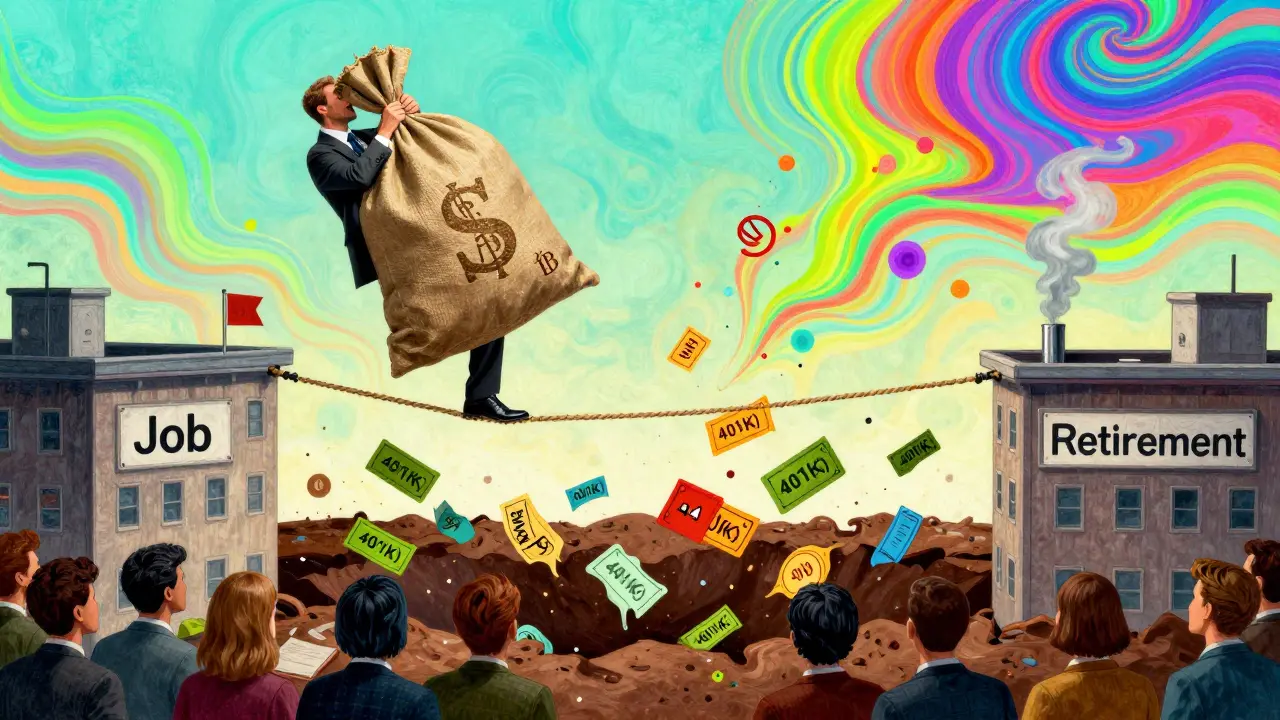
Imagine losing your job and your retirement savings in the same week. That’s not a horror movie plot-it’s what happens when too much of your retirement money is tied to your employer’s stock. It sounds safe: you work for a company, they give you stock, you believe in them, and you hold on tight. But when that company stumbles, you don’t just lose your paycheck-you lose the money you counted on to retire. And it’s more common than you think.
Why Your Company Stock Feels Safe (But Isn’t)
Many employees think holding company stock in their 401(k) or ESOP is a smart move. After all, you see the company every day. You know the product. You’ve watched it grow. Maybe you even got a bonus in stock last year. It feels like insider knowledge. But here’s the truth: your job and your retirement are already linked. You get paid by the company. You get benefits from the company. Now, if you put 60%, 70%, or even 90% of your retirement savings into that same company’s stock, you’re doubling down on one bet-and it’s the riskiest kind.Financial advisors agree: no single stock should make up more than 10% to 15% of your retirement portfolio. But according to industry data, many ESOP participants hold over 50% of their retirement assets in company stock. Some even hold 100%. That’s not investing. That’s gambling with your future.
The Double Jeopardy Trap
This is where the real danger kicks in. Most investment risks are isolated. If Apple’s stock drops, you lose money-but you still have your job. If your bank fails, you might lose interest on your savings-but your paycheck keeps coming. With employer stock, you lose both at once.When a company runs into trouble, layoffs often follow. At the same time, the stock price crashes. Employees who held heavy positions suddenly find themselves unemployed with a retirement account worth half of what it was a year ago. There’s no safety net. No diversification. No backup plan. Georgetown University’s Center for Retirement Initiatives (2023) calls this the “double jeopardy” scenario-and it’s exactly why concentrated employer stock is one of the most dangerous retirement mistakes.
Think of it this way: if your company is a small business, a single supplier problem, a bad quarter, or a new competitor can tank its value. If it’s a big company, a scandal, regulatory shift, or economic downturn can do the same. You don’t need a collapse to hurt you. A 30% drop in stock value, combined with a layoff, can set your retirement back 10 years.
What’s Worse Than Bad Stock? Good Stock That Never Changes
Some people hold onto company stock because they think, “It’s done well so far, why sell?” But past performance doesn’t protect you from future risk. In fact, the longer you hold, the more dangerous it becomes. Employees who stay with a company for 15 or 20 years often accumulate massive stock positions. They’ve seen the company thrive. They’ve celebrated milestones. They’ve felt proud. That emotional connection makes them reluctant to sell-even when logic says it’s time.And then there’s the tax trap. When you sell company stock from an ESOP or 401(k), you may owe taxes on the gain. But if you wait too long, you might miss the window to use favorable tax treatment like Net Unrealized Appreciation (NUA). Many employees don’t even know NUA exists. Others are scared of the tax bill. So they do nothing. And the risk just grows.
How You Got Here (And Why It’s Hard to Fix)
Most people don’t wake up one day and decide to overload on company stock. It happens slowly. You get stock as part of your bonus. You’re told, “This is how we build wealth together.” You see coworkers holding it. You think, “If they’re doing it, it must be safe.” You don’t get a choice because your 401(k) only offers company stock as an option. Or you’re not given enough information to make a better decision.Companies often encourage it. They host “stock appreciation days.” They send emails about “your ownership.” They make you feel like you’re part of the team. But here’s the reality: companies benefit from this arrangement. Their employees are more loyal. Their stock price stays stable because workers keep buying. And if things go south? The employees bear the cost.
Fixing it isn’t easy. You might be under a vesting schedule that locks your shares for another two years. You might not have other investment options in your plan. Or you might not know where to start. That’s why so many people stay stuck-even when they’re scared.
How to Protect Yourself
You can fix this. But you have to act. Here’s how:- Check your numbers. Log into your retirement account. How much of your balance is in company stock? If it’s over 15%, you’re in danger zone.
- Know your plan rules. Does your 401(k) or ESOP let you sell shares? When? Are there restrictions? Can you transfer shares to a brokerage account?
- Use NUA if you can. If you have company stock in a 401(k) and you’re over 59½ or have left the company, you might qualify for Net Unrealized Appreciation. This lets you pay long-term capital gains tax on the growth, not ordinary income tax. Talk to a tax pro.
- Diversify gradually. Don’t sell everything at once. Start by selling 5% a year. Reinvest in low-cost index funds. You’ll reduce risk without triggering a huge tax bill.
- Get professional advice. A fee-only financial planner who understands ESOPs and retirement plans can help you navigate the tax rules and timing. Don’t rely on your HR department-they’re not financial advisors.

What’s Changing? (And What’s Not)
The SECURE 2.0 Act (2023) made some changes to retirement plans, but it didn’t fix the concentration problem. It actually made ESOPs easier to adopt, which means more workers could end up in this situation. There’s no federal law forcing companies to give employees diversified investment options. ERISA requires fiduciaries to act prudently-but it doesn’t define “prudent” when it comes to stock concentration.Some companies are starting to wake up. A few now offer automatic diversification after five years of service. Others provide free financial counseling. But most still don’t. That means the responsibility falls on you.
Real Consequences, Real Stories
In 2022, a mid-sized manufacturing company in Ohio shut down after a supply chain collapse. Over 400 employees lost their jobs. The company stock, which had been the primary investment in their 401(k)s, dropped 87% in six months. Many had no other retirement savings. One employee, who had worked there for 22 years, told a reporter: “I thought I was building wealth. Turns out I was just betting my life on a company that didn’t know how to adapt.”These aren’t rare cases. They’re symptoms of a system that lets employees believe they’re safe while quietly stacking the odds against them.
Bottom Line: Your Retirement Isn’t a Loyalty Program
Your employer might thank you for your loyalty. But your retirement account doesn’t care how long you’ve been there. It only cares about how diversified your investments are. Holding too much company stock isn’t patriotism-it’s a financial blind spot. And blind spots kill portfolios.You don’t need to sell everything tomorrow. But you do need to start reducing your exposure. Even cutting your company stock in half can make a huge difference. If you’re unsure where to begin, pull your latest statement. Look at the numbers. Ask yourself: if this company disappeared tomorrow, would I still be able to retire?
If the answer is no, then you’re not just investing. You’re risking everything you’ve worked for.
Is it ever okay to hold a lot of company stock in my retirement account?
It’s okay to hold some company stock-especially if you’re young and have time to recover. But holding more than 10% to 15% of your retirement portfolio in a single stock is considered risky by most financial advisors. If your company stock makes up over 50% of your 401(k) or ESOP, you’re in danger zone. The more you hold, the more your financial future depends on one company’s performance-and that’s not a strategy, it’s luck.
What’s the difference between an ESOP and a 401(k) with company stock?
An ESOP is a retirement plan designed to invest primarily in company stock. In many cases, it’s the only retirement option employees have. A 401(k) is a broader plan that usually offers multiple investment choices, including mutual funds, ETFs, and sometimes company stock. The problem happens when a 401(k) also lets you invest heavily in company stock-turning what should be a diversified plan into a single-stock gamble. The key difference is choice: ESOPs often lack it. A good 401(k) gives you options.
Can I be forced to sell my company stock when I leave the company?
No, you can’t be forced to sell. But some companies have rules that require you to liquidate your shares within a certain time after leaving-usually 60 to 90 days. Others let you keep the stock in the plan. Either way, you’ll need to decide whether to sell, transfer to a brokerage, or hold. If you’re unsure, get help. Waiting too long can mean missing tax advantages like NUA or getting stuck with illiquid shares.
Why don’t companies warn employees about this risk?
Companies benefit from employees holding their stock. It boosts morale, reduces turnover, and keeps the stock price stable. They’re not required by law to warn you about concentration risk. In fact, many actively encourage it through bonuses, matching contributions in stock, and internal communications. It’s not malicious-it’s systemic. The system rewards loyalty over financial safety. That’s why you have to take responsibility for your own portfolio.
What should I do if I can’t diversify because my 401(k) only offers company stock?
If your 401(k) only offers company stock, you’re in a tough spot. First, make sure you’re contributing enough to get the full employer match-even if it’s in stock. Then, look for other ways to save for retirement: open a Roth IRA, contribute to a Health Savings Account (HSA), or invest outside your employer’s plan. You can’t fix your 401(k), but you can build wealth elsewhere. And if you leave the company, roll your 401(k) into an IRA where you’ll have full control over your investments.
John Weninger
February 9, 2026 AT 04:44Man, I just checked my 401(k) and holy crap-I’ve got 72% in company stock. I thought I was being smart, staying loyal, building equity... turns out I was just playing Russian roulette with my retirement.
Thanks for laying this out so clearly. I’m gonna call my HR rep tomorrow and ask about NUA. Never even heard the term before. Also gonna start selling 5% a month. No more heroics. Just steady, dumb-safe moves.
Also, shoutout to the guy who mentioned ESOP vs 401(k). That’s the real kicker-when your ‘retirement plan’ only gives you one option, that’s not a benefit. That’s a trap wrapped in a company hoodie.
Omar Lopez
February 9, 2026 AT 06:48The notion that ‘company loyalty’ equates to ‘financial prudence’ is not merely misguided-it is a pathological delusion perpetuated by corporate propaganda masquerading as community-building.
It is statistically indefensible to hold >15% of one’s retirement portfolio in a single equity instrument, particularly one whose cash flow is directly tied to one’s employment. The correlation between job security and stock performance is not a feature-it is a systemic hazard.
Furthermore, the SECURE 2.0 Act’s failure to mandate diversification thresholds is not an oversight; it is a legislative abdication of fiduciary duty to the public. ERISA’s ‘prudence’ standard remains dangerously vague because it was written by lawyers who have never held a mutual fund.
And yet, here we are-workers voluntarily surrendering autonomy to corporate balance sheets, mistaking corporate branding for financial literacy.
Jonathan Turner
February 9, 2026 AT 19:05Oh wow, another ‘financial advisor’ telling people to ‘diversify’ like it’s some kind of magic spell.
Let me guess-you also think buying gold and crypto ‘hedges’ your portfolio? Nah. The real hedge? Working for a company that pays you, gives you benefits, AND lets you own a piece of it. That’s called building something. Not playing ETF roulette.
And don’t even get me started on ‘NUA’-like some tax loophole is gonna save your retirement when your ‘dumb’ 401(k) actually outperformed the S&P for 12 years straight?
People who panic-sell company stock are the same ones who sold Bitcoin at $20k. You don’t get rich by being scared. You get rich by sticking with winners. And if your company’s a good one? Then stop being a coward.
Also, ‘double jeopardy’? Nah. That’s just karma for people who don’t believe in American capitalism. Get a real job.
Robert Shurte
February 11, 2026 AT 00:24There is a quiet, almost tragic irony in how we construct meaning around work: we don’t just work for a paycheck-we work for identity. We wear the logo. We celebrate the anniversary. We quote the mission statement. And in doing so, we collapse the distinction between self and corporation.
Our retirement accounts become altars to this identity. We pour our labor into the stock, and then we worship it-believing that if we hold long enough, the company will reward us not just financially, but existentially.
But the market does not care for loyalty. It does not honor tenure. It does not remember your overtime hours or your birthday cake.
And so, when the stock drops, we don’t just lose money-we lose the story we told ourselves about who we are. That’s the real double jeopardy.
Perhaps the solution isn’t diversification. Perhaps it’s grief. We must mourn the myth of the company as family. And then, slowly, we must build a new story-one where our worth isn’t tied to a ticker symbol.
Erika French Jade Ross
February 12, 2026 AT 11:52