Broker Bonus Calculator
Calculate the actual net value of your brokerage bonus after taxes and opportunity costs.
Net Value Result
Real-world insight: The IRS taxes brokerage bonuses as ordinary income. Your net value is typically 30-50% less than the advertised amount. If you're not planning to keep the money locked up for the full period, the promotion isn't worth it.
Everyone loves a free bonus. When a brokerage offers you $500 just for moving your money over, it feels like a win. But here’s the truth most ads won’t tell you: broker promotions aren’t free money. They’re a trade. And the trade often costs you more than you think.
What You’re Really Signing Up For
Brokerage promotions aren’t charity. They’re a customer acquisition tool. The big firms know most people won’t stay long. So they offer cash - but only if you lock your money in for months or even years. The average bonus ranges from $100 to $1,000 per $1 million transferred. Sounds great? Until you read the fine print.Most promotions require you to transfer at least $50,000 in settled cash or fully paid securities. Cryptocurrencies, options, and margin positions don’t count. You can’t move your Bitcoin and expect a bonus. You can’t move a $40,000 portfolio and get half the reward. These bonuses are all-or-nothing. If you’re $500 short of $100,000? No bonus. Period. Fidelity, for example, explicitly states they don’t pro-rate - even if you’re $1,000 under the next threshold on the evaluation date.
Lockup Periods: The Hidden Trap
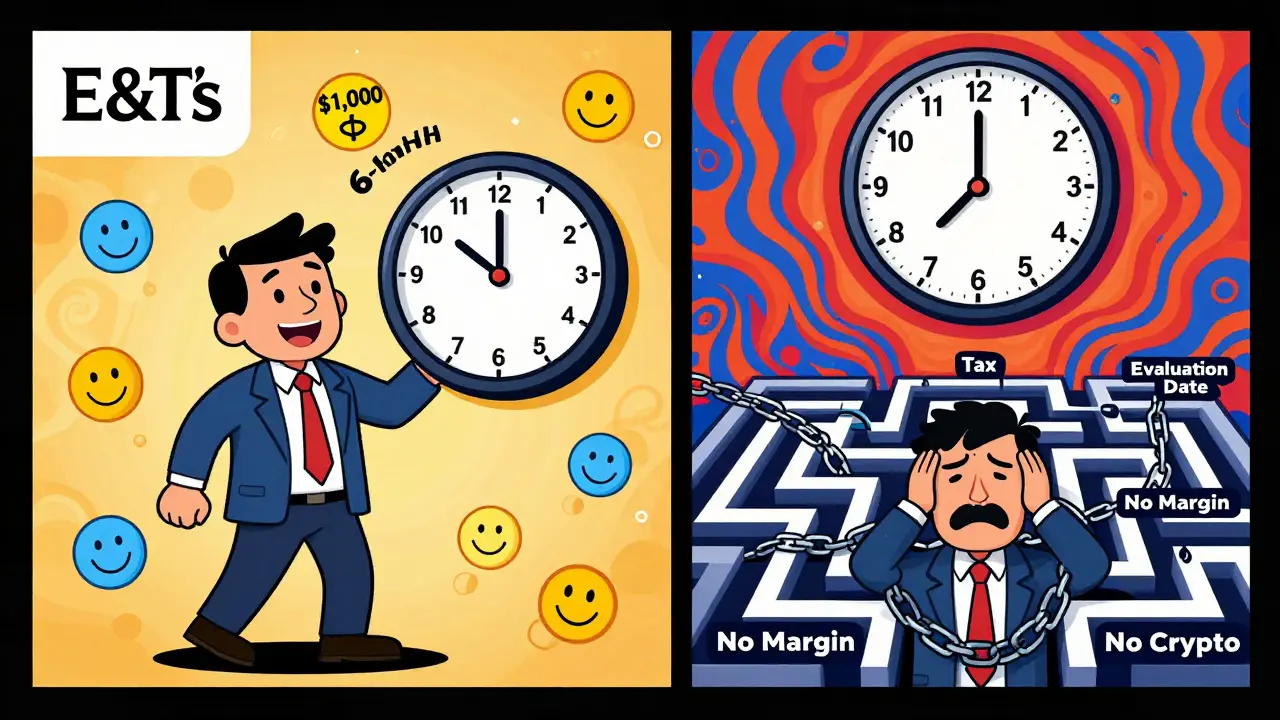
This is where most people get burned. The lockup period is the time you must keep your assets in the new brokerage before you can withdraw them without penalty. It’s not a suggestion. It’s a contract.Most brokerages require a 6- to 12-month lockup. Charles Schwab used to offer 6 months, but now pushes 12 months for larger transfers. Fidelity? They’re the outlier. Users report lockups of 12 to 18 months - longer than most competitors. Interactive Brokers has held steady at 12 months since 2023. Meanwhile, E&T keeps it simple: 6 months, clear terms, and a reputation for actually paying out.
Here’s the catch: the clock doesn’t start when you initiate the transfer. It starts when your assets are fully settled. That’s usually 7 to 14 days after you submit paperwork. Why? Because brokerage transfers take time. FINRA rules say they must complete within 3-5 business days, but settlement - meaning the money or shares are officially yours - takes longer. If your portfolio drops 5% during that window and you’re now $2,000 under the minimum? You lose the bonus. According to Schwab’s 2022 audit, 23% of failed bonus claims come from this exact issue.
Qualification Rules: No Mercy
It’s not enough to transfer the money. You have to keep it there. Most brokerages require you to maintain the minimum asset level through one or more evaluation dates. JPMorgan Wealth, for example, checks your account balance at the 60-day mark. If you pulled out $10,000 to buy a car at day 50? You’re disqualified.And it gets worse. Some firms require you to keep the assets in a self-directed account. JPMorgan won’t let you move into a managed advisory account during the lockup. Schwab may require you to do at least one trade per month. Fidelity has been known to audit account activity and deny bonuses if they think you’re just sitting on the money.
There’s no grace period. No warning. One day your account looks good. The next, you get an email: “Bonus not awarded.” And there’s no appeal.
Taxes: The Silent Killer
Here’s the part no one talks about until it’s too late: the bonus is taxable income.If you get $600 or more, the brokerage sends you a 1099 form. That means the IRS knows. And you owe taxes on it. For most people, that’s 22-35% in federal and state taxes combined. A $750 bonus? You’re left with $500 after taxes. A $1,000 bonus? You pay $250-$350 in taxes. That’s a 25-35% cut right off the top.
Financial advisor David Weliver pointed this out in a 2022 Investopedia interview: “Promotions are advertised as cash, but the real value is net of taxes. Most people don’t realize they’re paying taxes on a bonus they didn’t even earn yet.”
Some people try to avoid this by moving the bonus into a Roth IRA. But that doesn’t work. The bonus is still taxable income. You can’t hide it. The IRS doesn’t care if you reinvest it. You pay taxes on the bonus - period.
Who Pays the Most? Who’s the Most Honest?
Not all brokerages play the same game.Charles Schwab leads in bonus size. In early 2023, they offered $2,000 for $2 million transferred. But their 12-month lockup and strict evaluation rules make it risky. Fidelity offers less - often 15-20% lower than competitors - but touts better research tools. Still, users on Bogleheads report frustration: “They promise the bonus, then find a reason not to pay.”
E&T, a discount brokerage, is the outlier. They offer $100 per $50,000 transferred with a clean 6-month lockup. Their 2023 survey of 1,500 users showed 92% satisfaction. Why? Because they don’t hide the rules. You know exactly what you’re getting.
Full-service firms like JPMorgan Wealth offer the biggest perks - dedicated advisors, estate planning, tax help - but demand 18-month lockups and prohibit you from switching account types. If you want a human advisor during the lockup? Too bad. You’re stuck in a self-directed account.
What’s Changing in 2025?
Regulators are watching. In 2021, the SEC fined TD Ameritrade for not clearly disclosing lockup terms. In 2022, they took action against 12 brokerages for misleading promotion language. FINRA Rule 2310 now requires all advertising to be accurate - no more “$1,000 bonus!” without a footnote explaining the 12-month hold.Interactive Brokers introduced a smart update in January 2024: if you deposit 120% of the minimum, your lockup drops from 12 to 6 months. Schwab launched a real-time bonus tracker in late 2023 so you can see your progress.
Deloitte predicts a bigger change by 2025: regulators will require brokerages to show the net present value of the bonus - factoring in tax impact and the cost of being locked in. That means ads might soon say: “$750 bonus, but $300 in taxes + $150 opportunity cost from being locked up = $300 real value.”
Should You Do It?
Only if you’re ready to commit.If you’re planning to move your money anyway - and you’re not touching it for a year - then yes. A $500 bonus after taxes is still $300 in your pocket. But if you’re hoping to get rich quick, or you think you’ll need cash in 6 months? Walk away.
Here’s the rule of thumb: If the lockup is longer than your investment horizon, it’s not worth it. If the bonus is under $500 after taxes, it’s probably not worth the hassle. And if you’re unsure about the rules? Don’t sign up. Read the terms. Print them. Keep them. Ask for clarification in writing.
Because in the end, broker promotions aren’t about giving you money. They’re about testing how much you’re willing to give up to get it.
Are broker bonuses really free money?
No. Broker bonuses are taxable income, and you must keep your assets locked in for months - sometimes over a year - to qualify. After taxes and lost flexibility, the real value is often 30-50% lower than the advertised amount.
Can I transfer part of my portfolio and still get the bonus?
No. Most brokerages require you to transfer the full minimum amount in one go. Partial transfers don’t count. You also can’t mix asset types - only settled cash and fully paid securities qualify. Cryptocurrencies, options, and margin positions are excluded.
What happens if I withdraw money before the lockup ends?
You lose the bonus. Period. Most brokerages don’t warn you - they just deny the payout. Some will even claw back the bonus if they find out later. There’s no grace period, no second chance.
Why do some brokerages have longer lockups than others?
Longer lockups usually mean bigger bonuses. Industry data shows a direct link: each extra month of lockup increases the average bonus by 8.3%. Full-service firms like JPMorgan use long lockups to lock in high-net-worth clients. Discount brokers like E&T use shorter lockups to build trust.
Do I need to file taxes on my brokerage bonus?
Yes. Any bonus over $600 triggers a 1099 form. You must report it as ordinary income on your tax return. The tax rate depends on your bracket - typically 22-35%. There’s no way around it, even if you reinvest the money.
Can I avoid the lockup by moving assets to a different account within the same brokerage?
No. Lockups apply to the entire account. Moving money from a taxable account to an IRA within the same brokerage still counts as a withdrawal. Most firms track asset movement across all account types and will deny the bonus if you shift funds during the lockup period.
How do I know if a promotion is worth it?
Calculate the net value: bonus minus taxes, minus opportunity cost. If you’re not planning to touch the money for the lockup period, and the bonus is over $1,000 before taxes, it might be worth it. Otherwise, look for brokerages with shorter lockups and transparent terms - like E&T.
John Weninger
February 8, 2026 AT 21:50Just wanted to say thanks for laying this out so clearly. I got burned last year thinking I could move $80k and get the $1k bonus - ended up with nothing because my settlement got delayed by a weekend. Never again. Now I wait until I’m 100% sure I won’t touch the money for a full year. Honestly, if you’re not planning to stay put, skip it. The stress isn’t worth the cash.
Also, E&T’s transparency is a breath of fresh air. No games. Just clear terms. I switched to them after this mess and haven’t looked back.
Omar Lopez
February 9, 2026 AT 07:04It is, of course, imperative to recognize that the structural incentives inherent in brokerage promotions are not merely transactional but deeply embedded within the broader capitalist apparatus of customer acquisition. The so-called 'bonus' is, in truth, a liquidity trap disguised as altruism-a carefully engineered behavioral nudge predicated upon the assumption of temporal myopia among retail investors. One must, therefore, evaluate the opportunity cost of capital lockup not merely in monetary terms, but in terms of foregone portfolio rebalancing, tax-loss harvesting windows, and macroeconomic exposure shifts.
Moreover, the IRS’s treatment of such bonuses as ordinary income-rather than capital gains-represents a fundamental misalignment with the nature of the transaction, which is, at its core, a deferred compensation mechanism. One wonders why regulatory bodies have not yet classified these as deferred compensation under IRC §409A.
Jonathan Turner
February 9, 2026 AT 09:37Oh wow. A 12-month lockup? How dare they. I’m sure the poor little retail investor just can’t handle having their money sit still for a year. Maybe they should’ve stayed in their 0.01% APY savings account where the bank ‘loves’ them.
And don’t even get me started on people who think they can outsmart Fidelity. You think you’re slick moving $99,500 hoping for a pro-rated bonus? Nah. They’ve got algorithms that detect desperation. You don’t get a gold star for almost making it. You get a ‘bonus denied’ email and a pat on the head from a robot.
Also, taxes? Yeah, that’s why you don’t do this for $500. Do it for $1,500+ and then pay your 28% like a grown-up. Stop whining. If you can’t afford to lose $300 to taxes, you shouldn’t have $100k to move in the first place.
Robert Shurte
February 9, 2026 AT 22:14There’s something profoundly ironic about the entire system: we’re told to ‘invest wisely,’ to ‘think long-term,’ to ‘avoid emotional decisions’-and then we’re lured in by a $750 bonus that demands we do the exact opposite: lock our money away, ignore market shifts, and sacrifice flexibility for a single, finite payout.
It’s not just a financial transaction-it’s a psychological test. The brokerage isn’t just evaluating your portfolio; it’s evaluating your patience, your discipline, your willingness to surrender autonomy for a fleeting reward.
And yet… if you’re already planning to move, and you’re not touching it for a year? Then yes-it’s a gift. A very carefully worded, heavily documented, tax-deducted gift. But a gift nonetheless.
I print the terms. I read them aloud. I date them. I keep them in a folder labeled ‘Promotions I Didn’t Screw Up.’ Because the real bonus isn’t the cash-it’s the peace of mind that comes from knowing you didn’t fall for the trap.