Broker Outage Preparedness Calculator
How prepared are you for a trading platform outage?
Assess your readiness based on the article's key recommendations. Outages can last 127+ minutes during market crashes. This tool will show your risk level and what you should do next.
Your Outage Readiness Assessment
When your trading platform crashes, you can’t just wait it out
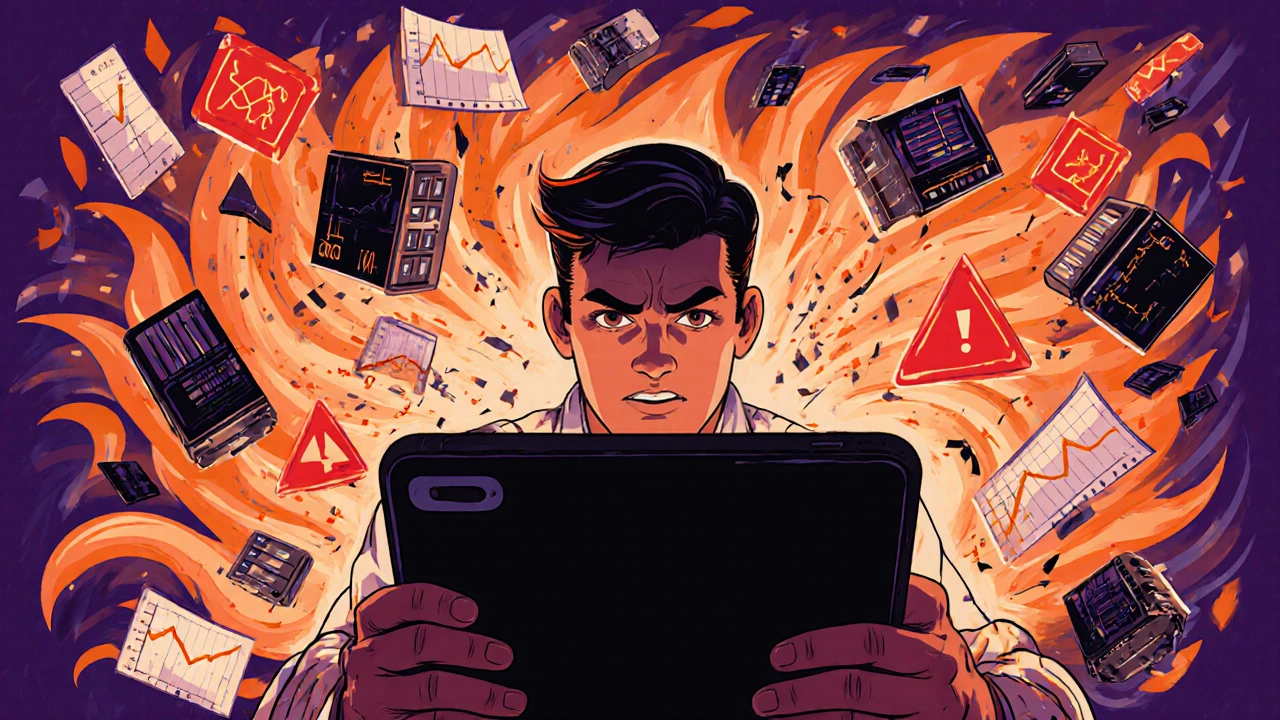
It’s 9:45 a.m. The market is tumbling. Your portfolio is bleeding. You open your app-black screen. Refresh. Try the website. Same thing. Phone support? Busy signal. You’re locked out while the S&P 500 drops 3% in 20 minutes. This isn’t rare. In August 2024, Charles Schwab’s platform went down for over two hours during a market crash, affecting more than a million users. Fidelity, TD Ameritrade, and others have had similar breakdowns. These aren’t glitches-they’re systemic failures. And if you’re only using one broker, you’re gambling with your money.
Why broker outages keep happening
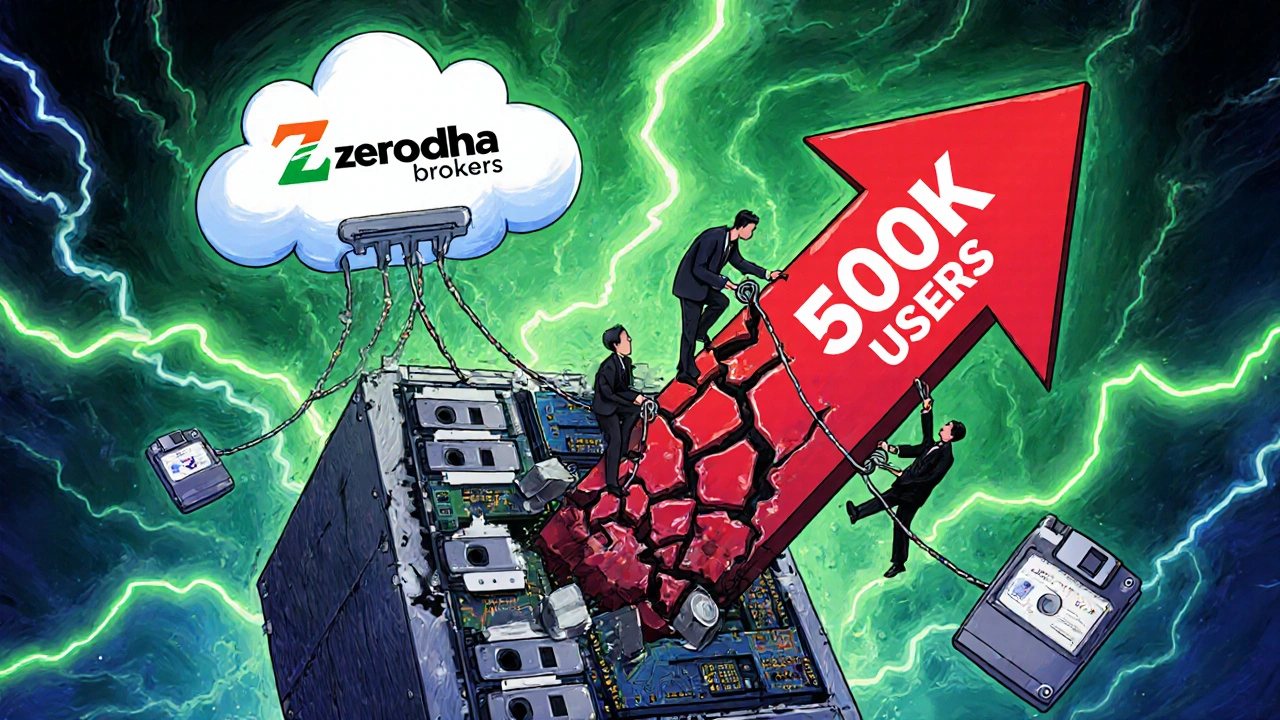
Most brokerage platforms were built for a time when people traded once a week, not every 10 minutes. The software behind apps like Robinhood, E*TRADE, or even Vanguard still runs on old code designed to handle 10,000 users at once. Today, during volatility, they get hit with 500,000. That’s not a bug-it’s a design flaw.
According to IOSCO’s 2023 report, 68% of outages come from software issues-overloaded servers, broken order queues, or failed login systems. Another 27% are hardware failures: a single server dies, and the whole platform goes offline because there’s no backup. Only 38% of brokers offer any kind of API-based backup trading system. The rest? They’re stuck with one system, one server, one point of failure.
Even worse, many brokers still don’t test for extreme conditions. PwC Legal found that 74% of major firms can’t handle more than 50,000 concurrent users. When the Dow drops 1,000 points in a day, millions of people try to sell at once. The system breaks. And when it does, you can’t place orders, cancel stop-losses, or even check your balance.
How long do outages really last?
It’s not a few minutes. During peak volatility, the average outage lasts 127 minutes. Fidelity’s 2020 crash lasted nearly five hours. In March 2023, a single server failure at a major U.S. broker took down mobile trading for 3 hours and 17 minutes. That’s long enough for a 10% swing in your holdings. And during that time, you’re blind. You can’t react. You can’t protect your money.
And it’s not just about trading. You also can’t access your cash. If you need to move funds to cover an emergency, or if you’re trying to rebalance after a market drop, you’re stuck. Settlement rules (T+2) mean even if you finally get back in after the market closes, your trade won’t execute until the next day. That’s a full 24 hours of risk.
What you can do right now to protect yourself
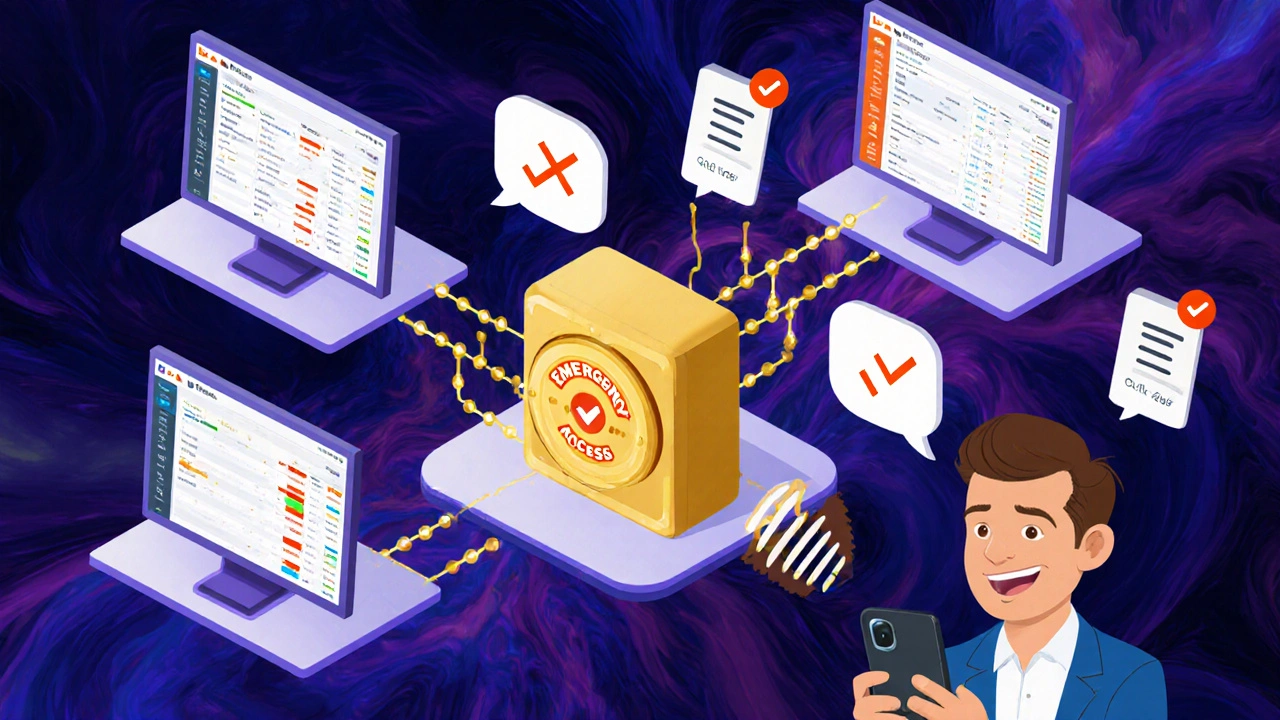
Waiting for your broker to fix things isn’t a strategy. Here’s what actually works:
- Open accounts at two or more brokers-ideally three. Investors with multiple accounts are 78% less likely to be fully locked out during an outage, according to Mortgage Connector’s 2024 analysis. Keep a small balance in each. You don’t need to trade all the time, but you need access when it matters.
- Turn on SMS alerts. Almost all major brokers now offer them. Set up notifications for platform status. If your primary broker goes down, you’ll know immediately-not when you see a Reddit post or a friend’s tweet.
- Learn how to trade by phone. Yes, it’s slow. Yes, it’s frustrating. But 67% of brokers still offer phone trading. Know the number. Know the ID you need. Practice it once. It takes 15-25 minutes to get through, but it’s better than nothing. Interactive Brokers has the most reliable phone system-4.3/5 stars in outage reviews.
- Use standing orders. Set up automatic transfers to a separate bank or brokerage account during high-volatility periods. If your main account goes down, your cash is already safe elsewhere.
- Check the official status page. Don’t trust social media. Look for the broker’s official outage dashboard. Zerodha and FYERS publish real-time uptime stats. If your broker doesn’t, that’s a red flag.
Watch out for scams during outages
When platforms go down, scammers move in fast. In August 2024, 34% of affected users received fake emails pretending to be from their broker-offering "urgent access links" or "compensation forms." These are phishing attempts. Never click links in unsolicited messages. Never give up your password or 2FA code.
Real brokers will never ask you to log in via email. They’ll direct you to their official website or app. If you’re unsure, type the URL yourself. Don’t search for it. Don’t click a link. Go directly.
What your broker should be doing (but probably isn’t)
Regulators are catching on. IOSCO now requires brokers to:
- Run quarterly stress tests simulating 500% trading volume spikes
- Monitor 147 performance metrics in real time
- Submit root cause reports within 14 days of any outage over five minutes
But enforcement is weak. FINRA fined two brokers $4.2 million in 2023 for repeated outages. That’s a drop in the bucket compared to the $2.3 billion in lost opportunities retail investors faced between 2020 and 2024. The SEC is pushing for new rules in 2025 to mandate minimum 99.98% uptime-similar to what the EU already requires. But until then, you’re on your own.
Who’s doing it right?
Not many. But some are leading:
- Interactive Brokers has maintained 99.99% uptime since 2021. Their infrastructure is built for scale. They offer API access, phone support, and real-time status updates.
- TradeStation grew 34% in 2023 because their platform stayed up during every major market drop. They use cloud-based redundancy and load balancing.
- Zerodha (India) publishes public outage reports. Their transparency cut complaints by 42%.
- FYERS launched a live status dashboard in July 2024. Customer satisfaction jumped 31 points.
If you’re choosing a broker, uptime isn’t a bonus-it’s a requirement. Look at their track record during past crashes. Don’t just pick the lowest fees.
What’s coming next
Technology is slowly catching up. Fidelity is testing blockchain-based order routing to bypass failed systems. AI-powered predictive maintenance (used by some hedge funds) could reduce outages by 65% by 2027, according to Deloitte. But for now, the system is still fragile.
By 2026, most U.S. brokers will be forced to upgrade. Until then, don’t rely on them. Don’t assume they’ll be there when you need them. Your money is your responsibility.
Final checklist: Are you prepared?
Before the next crash, ask yourself:
- Do I have accounts at two or more brokers?
- Have I tested phone trading with one of them?
- Do I have SMS alerts enabled for platform status?
- Do I know the official outage page for each broker I use?
- Have I set up automatic transfers to a safe account during volatility?
- Do I know how to spot a phishing email?
If you answered no to any of these, you’re not ready. Outages aren’t going away. They’re getting worse. The market doesn’t wait. Neither should you.
Why do trading platforms keep going down during market crashes?
Most platforms were built for low-volume trading and can’t handle the surge during market panic. They rely on outdated software and single-server systems. When millions of users try to sell at once, the system overloads and crashes. According to IOSCO, 68% of outages are caused by software issues, not hackers or cyberattacks.
Can I get compensated if my broker’s platform goes down and I lose money?
It’s rare. FINRA has handled over 12,800 arbitration cases related to outages since 2020, but 68% of rulings favored the broker. Brokers argue that market movements-not their platform-are what caused the loss. Unless you can prove gross negligence (like ignoring known system flaws), compensation is unlikely. Your best defense is prevention, not recovery.
Is it safe to use multiple brokers?
Yes, and it’s strongly recommended. Having accounts at different brokers spreads your risk. If one goes down, you can still trade on another. Most brokers are FDIC-insured or SIPC-protected, so your assets are safe regardless of which platform you use. The only downside is managing multiple logins-but that’s a small price compared to being locked out during a crash.
How do I know if my broker’s outage is real or just a glitch?
Check their official status page or social media accounts. Avoid relying on Reddit, Twitter, or emails. Legitimate brokers will post updates on their website under a "Status" or "System Alerts" section. If you’re unsure, call their customer service line directly using the number on their official website-not one you found in an email.
Should I switch brokers because of frequent outages?
If your broker has had three or more outages in the past year-especially during normal market conditions-yes. Reliability matters more than low fees. Brokers like Interactive Brokers and TradeStation have proven track records of uptime. Don’t wait for a crash to realize your platform can’t handle pressure.
Do mobile apps cause more outages than desktop platforms?
Not necessarily. Most outages affect both mobile and desktop because they share the same backend systems. But mobile apps often crash first because they’re lighter, less stable, and more prone to updates. If your app freezes, try the website. If both are down, it’s a full system failure.
What’s the fastest way to get help during an outage?
Call your broker’s phone trading line. Even if it’s busy, keep trying. Most brokers prioritize phone trades during outages because they’re slower and less likely to overload the system. Text alerts and status pages are useful for awareness, but phone is your only real option to act.
Graeme C
November 1, 2025 AT 00:00Let me tell you something - I got locked out during the March 2023 crash while trying to bail on a tech stock. My phone trade took 22 minutes to get through, but I saved 18% of my position. If you think ‘just refresh’ works, you’re living in a dream. I’ve got accounts at IBKR, Fidelity, and Webull now. No more gambling. You want reliability? Pay for it. Your portfolio’s worth more than your ego.
And yes, I’ve tested the phone system. I know the ID, the pin, the damn sequence. I practice it like a damn drill. You think this is optional? It’s not. It’s survival.
Stop waiting for your broker to fix shit. They won’t. They’re too busy optimizing their ad revenue, not your P&L.
Also - SMS alerts? Turn them on. I got mine set to ‘Platform Down’ and ‘API Unreachable.’ I’ve been warned 11 times this year. Saved me from panic-selling twice.
And for God’s sake, don’t click those ‘urgent access’ emails. I saw one that looked exactly like Schwab’s. Used their logo, their font, their color scheme. Took me 37 seconds to spot the subdomain was ‘schwab-support[.]xyz.’ Classic phishing. Don’t be the guy who loses his 401(k) to a Gmail template.
Astha Mishra
November 2, 2025 AT 03:09It is truly heartbreaking, is it not, how we have placed our trust in systems that were never meant to endure the weight of modern financial anxiety? We have built our lives around digital interfaces - sleek, silent, seemingly invincible - yet beneath their polished surfaces lies a foundation of brittle code, inherited from a time when trading was a quiet ritual, not a frenzied scream into the void.
When I first began investing in India, I used Zerodha. I remember the first time their status page went red - not because of a hack, not because of a server breach, but because 3 million users tried to sell Nifty futures at once. And yet, they did not vanish. They did not lie. They posted a simple update: ‘System under stress. Expected resolution: 1h 42m.’
That transparency, that humility - it was revolutionary. Here in the West, brokers treat outages like embarrassing family secrets. They whisper about them in press releases. They bury them in footnotes. But Zerodha? They publish graphs. They thank users for patience. They apologize, and then they fix it.
Perhaps the real failure is not in the software, but in our expectation that technology should be perfect - when all it ever was, was a tool. And tools, my friends, must be used with wisdom, not worship.
I now hold accounts in three countries. Not for diversification alone - but for sanity. When one system collapses, I breathe. I do not panic. I switch. I adapt. And in that small act, I reclaim agency - not from the market, but from the illusion of control we were sold.
So yes, open multiple accounts. Enable SMS. Learn the phone number. But more than that - learn to trust yourself more than you trust a screen.
And if your broker still doesn’t have a public status page? Walk away. Your money deserves better than silence.
Kenny McMiller
November 3, 2025 AT 22:43Brokers are basically glorified APIs with a frontend and zero redundancy. The whole system’s architected like a single-threaded Node.js app running on a Raspberry Pi - except instead of serving cat memes, it’s handling $200B in orders. 68% of outages are software? Yeah, because they’re still using Java 8 and a 2012 version of Tomcat. No containerization, no auto-scaling, no blue-green deploys. Just ‘hope the server doesn’t melt.’
And don’t even get me started on the T+2 settlement. That’s a relic from when trades were printed on paper and mailed. We’re in 2025 and your broker still can’t move cash faster than a fax machine.
IBKR’s the only one doing it right. Their API is documented, their infrastructure is multi-AZ, and their status page is literally a GitHub repo with live metrics. Everyone else? They’re running on legacy mainframes with a React wrapper glued on top. It’s not incompetence - it’s institutional laziness. Why fix what’s ‘good enough’ to collect fees?
Phone trading? Yeah, it’s a pain. But if you’re not using it, you’re just a spectator. And spectators get slaughtered in a crash.
Also - ‘check the official status page’? Most brokers don’t even have one. If they do, it’s buried under 5 layers of marketing fluff. That’s not a feature. That’s a warning sign.
Dave McPherson
November 4, 2025 AT 04:52Oh sweet mercy. Another ‘financial literacy’ sermon from someone who thinks ‘diversifying brokers’ is a hedge fund strategy. Let me guess - you also keep emergency cash under your mattress and pray to the algorithm gods before every trade?
Newsflash: if you’re relying on your broker’s platform to not crash during a 3% market drop, you shouldn’t be trading at all. You’re not an investor - you’re a spectator with a Robinhood account and a Netflix subscription.
Interactive Brokers? Of course they’re reliable. They charge $1.50 per trade and make you fill out a 17-page risk disclosure before you can buy a single share of Apple. You think that’s coincidence? No. That’s the filter. The market doesn’t want you. It wants the 2% who actually know what a limit order is.
And don’t get me started on SMS alerts. You think getting a text that says ‘Platform Down’ is going to save you? That’s like getting a smoke alarm while your house is already in flames. You’re not preparing - you’re just doing performative safety rituals to feel better.
Real traders? They use API-driven bots. They’ve got backup liquidity providers. They don’t care if the app crashes - because they’re not looking at it. They’re watching order flow, volume spikes, and dark pool prints. The rest of you? You’re just emotionally attached to your portfolio like it’s your ex.
And if you’re still using Fidelity or Schwab? Congrats. You’re paying for a luxury car that runs on kerosene. The only reason you haven’t lost everything yet is because the market hasn’t had a real meltdown. When it does? You’ll be the guy screaming into the phone while your stop-loss never triggers.
Bottom line: stop blaming brokers. Blame yourself for thinking you’re qualified to be here.