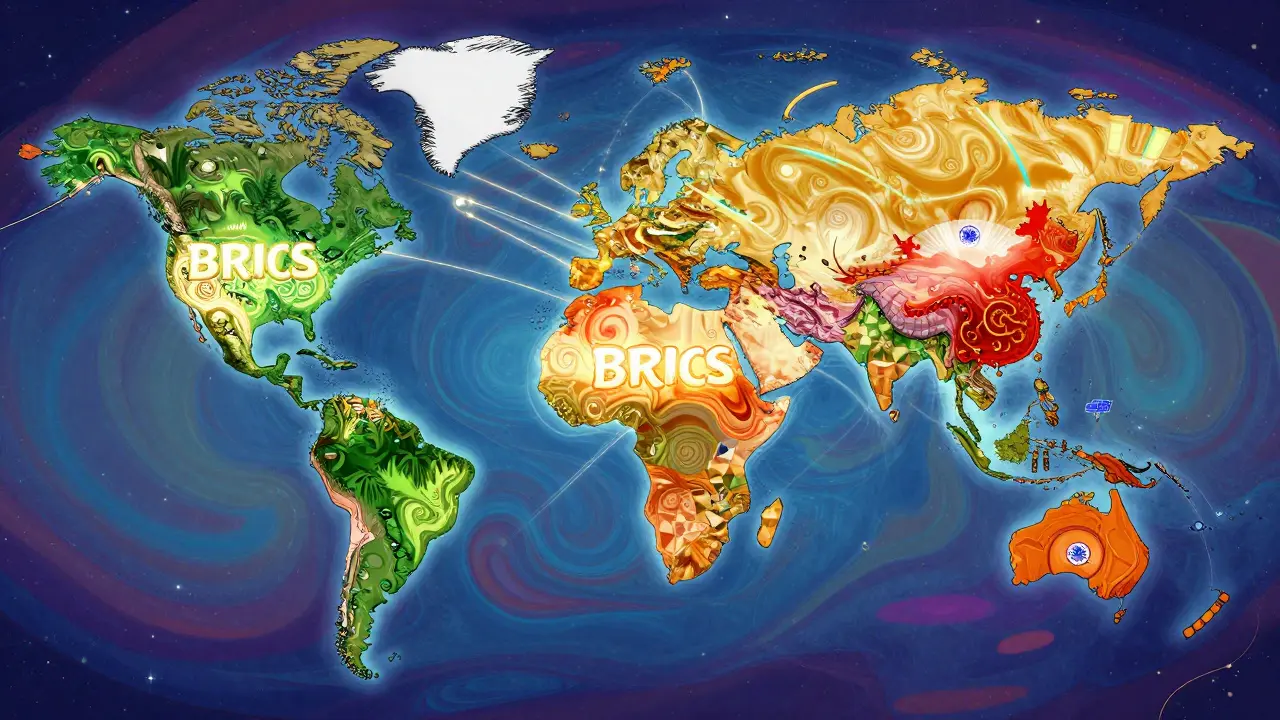
BRICS Investment Calculator
Evaluate BRICS Investment Opportunities
Select a BRICS country and sector to see potential returns and risk factors based on current economic conditions.
When you think of the next big thing in global investing, you might picture Silicon Valley startups or European tech giants. But the real shift is happening elsewhere - in the BRICS countries: Brazil, Russia, India, China, and South Africa. These aren’t just emerging economies anymore. They’re the backbone of a new economic order, and their influence is growing fast.
Back in 2001, Goldman Sachs economist Jim O’Neill coined the term BRIC to describe four fast-growing economies with massive potential. By 2010, South Africa joined, turning BRIC into BRICS. But what started as a financial label has become a powerful bloc. Today, BRICS isn’t just a concept - it’s an institution with its own bank, its own rules, and its own agenda.
What BRICS Really Is Today - And Who’s In
As of January 2025, BRICS isn’t just five countries anymore. It’s nine full members: Brazil, Russia, India, China, South Africa, Egypt, Ethiopia, Iran, and Indonesia. Ten more countries are officially partnered - including Nigeria, Thailand, Kazakhstan, and Malaysia - with over 40 others asking to join. This isn’t a club. It’s a movement.
Together, these nations make up 55% of the world’s population and nearly half of global GDP when measured by purchasing power parity (PPP). That’s more than the G7 combined. But here’s what most investors miss: BRICS isn’t about matching Western markets. It’s about building alternatives.
The New Development Bank: BRICS’ Secret Weapon
If you want to understand BRICS’ real power, look at the New Development Bank (NDB). Launched in 2014 with $100 billion in capital, it’s the bloc’s answer to the World Bank. And it’s working.
By 2024, the NDB had approved 91 infrastructure projects worth $34.4 billion. Most of them? In Africa and Asia. Ethiopia got $1.2 billion for a new railway. Indonesia got funding for clean energy grids. Brazil secured loans for rural water systems. The approval process? An average of 18 months - faster than the World Bank’s 24.
Unlike Western lenders, the NDB doesn’t force austerity or impose strict political conditions. That’s why countries like Egypt and Nigeria are lining up. For investors, that means more stable, long-term projects with local buy-in - less risk of sudden policy flips.
Energy, Food, and Raw Materials: The Real BRICS Advantage
BRICS doesn’t just talk about economic independence - it controls the essentials.
Five BRICS members rank in the world’s top 10 crude oil producers: Russia (3rd), China (4th), Iran (7th), UAE (8th), and Brazil (9th). Together, they pump over 30 million barrels a day. That’s nearly a third of global supply.
Food production? Even bigger. China and India grow over half the world’s rice. China, India, and Russia produce more than 40% of global wheat. Brazil and India dominate sugar cane - together, they make up two-thirds of global output. Indonesia and Malaysia (BRICS partners) control 89% of palm oil.
For investors, this isn’t just about commodities. It’s about supply chain control. If you’re betting on global food or energy prices, you’re betting on BRICS. And with climate pressures rising, these countries are the ones holding the keys to stability - or disruption.
Trade Within BRICS Is Booming - But Still Underdeveloped
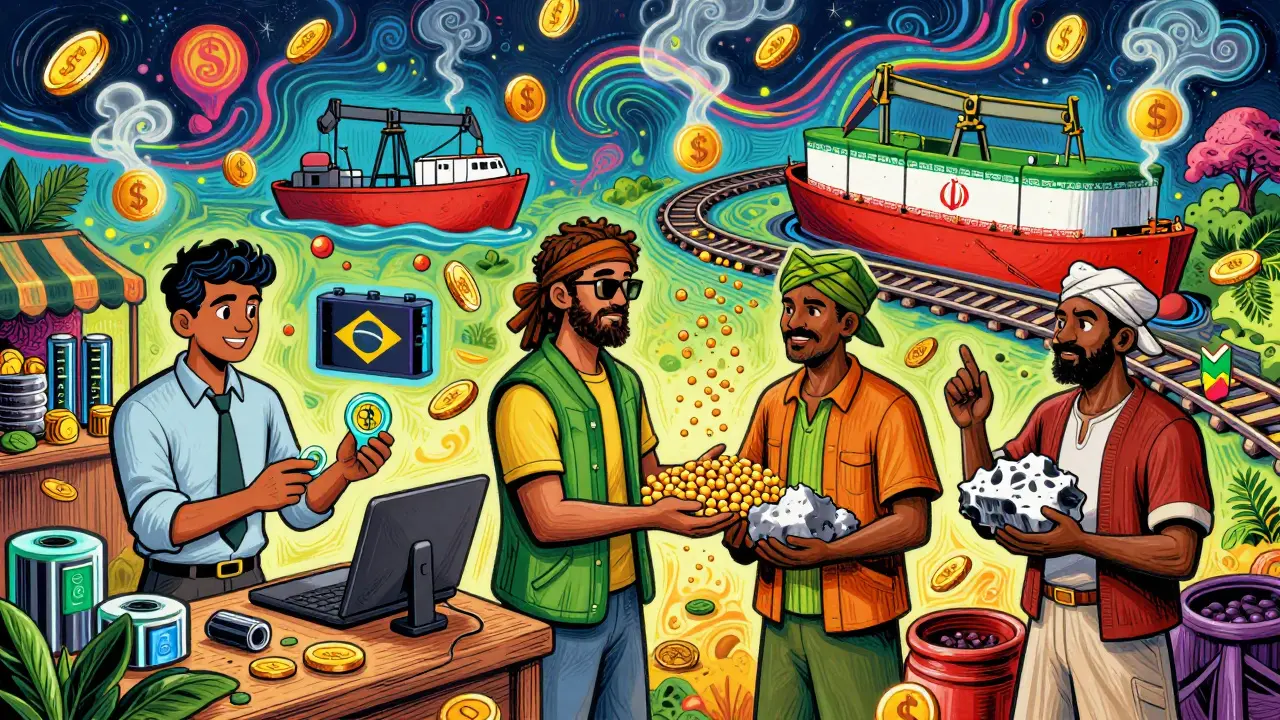
In 2024, intra-BRICS trade hit $624 billion - up 34% since 2020. That sounds impressive. But here’s the catch: it’s still only 18% of each country’s total trade. Most BRICS nations still trade more with the U.S., EU, or Japan than with each other.
Why? Because the system is still messy. Currency conversion is slow. Payment systems aren’t unified. The BRICS Trade Finance Facility, launched in 2023 with $10 billion, has only moved $850 million so far - mostly because banks still default to dollars and euros.
But change is coming. Brazil’s 2025 presidency is pushing to cut transaction costs by 25% by 2027. India and China are quietly testing local currency settlements. Iran and Russia are using gold and digital yuan to bypass sanctions. It’s not a revolution yet - but it’s a steady crawl away from the dollar.
The Big Tensions: India vs. China, Russia vs. Everyone Else
Don’t be fooled by the unity. BRICS is a coalition of rivals.
India and China are locked in a border dispute and a tech cold war. Indian officials privately worry China is using BRICS to expand its influence - especially in Africa. Meanwhile, Russia’s isolation after Ukraine has made it lean even harder on China, creating friction with Brazil and South Africa, who still want to trade with Europe.
South Africa’s economy is shrinking. Brazil’s political volatility scares investors. Egypt and Ethiopia are still rebuilding after debt crises. These aren’t stable, predictable markets. They’re complex, dynamic, and often contradictory.
That’s not a reason to avoid them - it’s a reason to invest smartly. You don’t bet on BRICS as a whole. You pick the right countries, the right sectors, and the right timing.
Who’s Winning? Where the Real Opportunities Are
Not all BRICS countries are equal. Here’s where the real value lies right now:
- India: Tech, manufacturing, and renewables. Its digital infrastructure is world-class. It’s becoming the factory for the West’s supply chain diversification. Solar power investment is surging - and the government is offering tax breaks for foreign firms.
- China: Still the engine. But now it’s shifting from export-led growth to domestic tech and green energy. EVs, batteries, and AI chips are where the money’s going. Don’t chase old manufacturing - chase innovation.
- Brazil: Agriculture and green energy. It’s the breadbasket of the world. And with COP30 coming to Rio in 2025, expect billions in climate financing. Look at agribusiness, sustainable forestry, and biofuels.
- Indonesia: New member, massive potential. 270 million people. A growing middle class. Nickel for EV batteries. Palm oil. Digital payments. It’s the next Vietnam.
- South Africa: Risky, but undervalued. Mining (platinum, gold, lithium) is its strength. The power grid is broken, but that means huge opportunity in renewables and microgrids.
Forget trying to buy a “BRICS ETF.” The real edge is in picking individual countries based on their strengths - not the group’s brand.
The Future: What’s Next for BRICS Investors
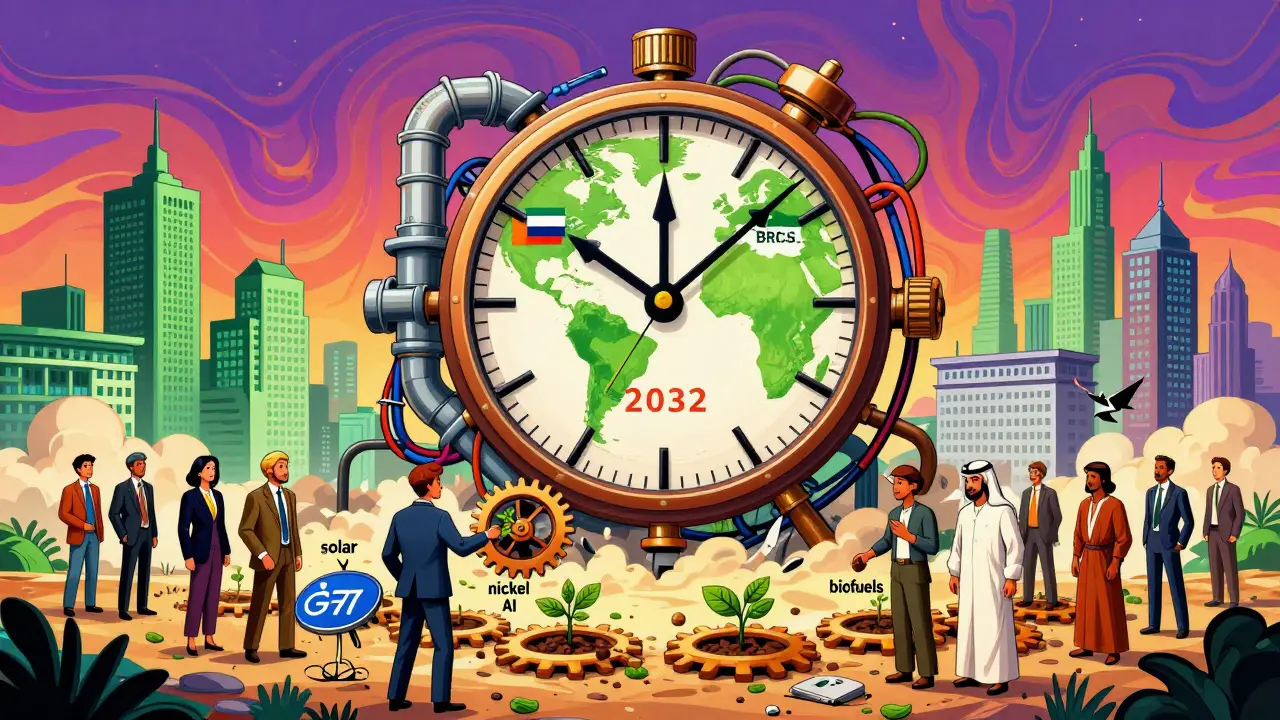
By 2032, Goldman Sachs predicts BRICS will surpass the G7 in nominal GDP. That’s not a guess - it’s based on population trends, urbanization rates, and tech adoption.
Two things will drive this: infrastructure and digital transformation. The NDB is just getting started. The BRICS Digital Health Platform launched in early 2025. Renewable energy commitments hit $50 billion by 2030. AI governance frameworks are being drafted.
And here’s the kicker: the U.S. and EU are still treating BRICS as a threat. That means they’ll keep imposing sanctions, restricting tech access, and limiting investment. But that’s exactly what’s pushing BRICS to build its own systems - faster.
If you’re waiting for stability, you’ll miss this wave. But if you’re ready for volatility with high upside, BRICS isn’t just an option - it’s the defining investment story of the next decade.
Are BRICS countries a good investment for individual investors?
Yes - but not as a single bloc. Each BRICS country has different risks and opportunities. India’s tech sector and Brazil’s agriculture offer strong growth potential. China’s innovation in EVs and batteries is unmatched. South Africa and Indonesia are undervalued but carry higher political and infrastructure risks. Diversify across countries, not just sectors.
Is the BRICS currency plan real? Should I prepare for a new BRICS dollar?
No, there’s no BRICS currency in the works - and there won’t be soon. While Russia and Iran want to ditch the dollar, China and India are cautious. They’re testing local currency trade deals, but full currency replacement is years away. Don’t bet on a new currency. Bet on the shift to non-dollar trade - it’s already happening.
How does BRICS compare to the G7 for investors?
The G7 is mature, stable, and slow-growing. BRICS is volatile, fast-growing, and underdeveloped. G7 markets offer dividends and low risk. BRICS offers growth and higher returns - but with more uncertainty. Think of it this way: G7 is your savings account. BRICS is your startup portfolio.
What sectors in BRICS are seeing the most foreign investment?
Renewable energy, digital infrastructure, agriculture tech, and critical minerals. India is attracting billions in solar and EV manufacturing. Indonesia is a magnet for nickel and battery supply chains. Brazil’s biofuels and sustainable farming are drawing ESG funds. China leads in battery tech and AI hardware. These aren’t trends - they’re structural shifts.
Should I avoid investing in Russia because of sanctions?
It depends. Direct investment in Russian companies is restricted for most Western investors. But indirect exposure is possible through commodities - like oil and gas exports to BRICS partners - or through funds that trade in local currency bonds. The risk is high, but the reward can be too. Only consider it if you’re comfortable with extreme volatility and legal gray areas.
What’s the biggest risk in BRICS investing right now?
Political fragmentation. BRICS countries don’t agree on much beyond trade. India and China are rivals. South Africa’s economy is fragile. Brazil’s government changes every four years. The biggest risk isn’t economic - it’s that the bloc fractures under pressure, causing sudden policy shifts or trade disruptions. Diversify across countries and avoid overexposure to any single member.
Final Thought: BRICS Isn’t About Replacing the West - It’s About Redefining It
BRICS doesn’t want to destroy the global system. It wants to make room for itself inside it. And it’s succeeding - not by force, but by scale, need, and persistence.
For investors, that means opportunity. Not in theory. Not in headlines. But in the factories of Gujarat, the soy fields of Mato Grosso, the solar farms of Rajasthan, the nickel mines of Sulawesi, and the digital payments platforms of Lagos.
The world is changing. And the money is moving - not to Wall Street, but to the places where the next billion people live, work, and buy.
Royce Demolition
December 24, 2025 AT 21:19Sabrina de Freitas Rosa
December 25, 2025 AT 16:11Erika French Jade Ross
December 26, 2025 AT 11:47Geoffrey Trent
December 28, 2025 AT 09:52John Weninger
December 30, 2025 AT 01:17