
ADR Dividend Tax Calculator
Calculate the actual dividend yield on ADRs after tax withholding and fees. Many investors miss the hidden tax implications.
Your ADR Dividend Results
* Tax treaty rates are often 15%, but depend on your country
* ADR fees typically range from $0.05 to $0.50 per share annually
* Always file a W-8BEN form to claim treaty benefits
Ever wondered how you can buy shares of a company like Nestlé, Samsung, or Alibaba without opening a foreign brokerage account? The answer lies in ADR stocks-American Depositary Receipts. These aren’t just fancy financial jargon. They’re the actual mechanism that lets everyday U.S. investors own pieces of foreign companies, trade them during U.S. market hours, and get dividends in U.S. dollars. And they’ve been doing this since the 1920s, when J.P. Morgan first created them to let Americans invest in a British department store. Today, over 2,600 ADRs represent companies from 65 countries, with a combined value of $1.2 trillion. If you’re investing in global markets, you’re probably already holding ADRs without even realizing it.
What Exactly Is an ADR?
An ADR is a U.S.-issued receipt that represents ownership of shares in a foreign company. Think of it like a voucher. A U.S. bank-called a depositary bank-buys shares of, say, Toyota on the Tokyo Stock Exchange. Then it bundles those shares into groups and issues ADRs that trade on the NYSE or Nasdaq. Each ADR might represent one share, five shares, or even ten shares of the original stock. The bank handles everything: currency conversion, dividend payments, taxes, and custody. You don’t need to deal with foreign exchanges, time zones, or language barriers. You just buy and sell ADRs like any other U.S. stock.
ADRs are denominated in U.S. dollars, trade during U.S. market hours (9:30 a.m. to 4:00 p.m. ET), and pay dividends in U.S. dollars. That’s the big win. Without ADRs, buying a share of a German company like Siemens would mean dealing with euros, paying foreign transaction fees, and waiting weeks for dividends to clear. With an ADR? It’s just like buying Apple or Tesla.
The Three Levels of ADRs
Not all ADRs are created equal. There are three levels, each with different rules, reporting requirements, and access to U.S. markets. Knowing the difference matters because it affects how much information you get, how easy it is to trade, and how safe your investment is.
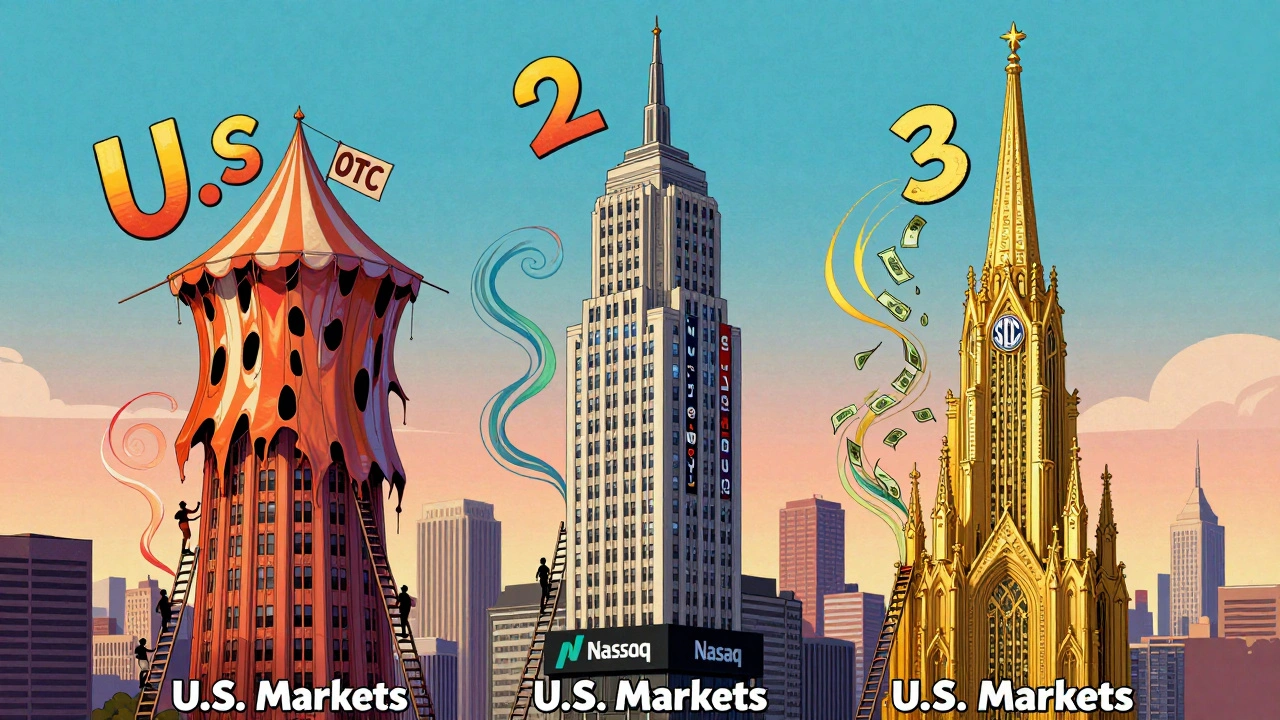
Level 1 ADRs are the simplest and most common. They trade over-the-counter (OTC), not on major exchanges like the NYSE. Companies using Level 1 ADRs don’t have to file full financial reports with the SEC-just a basic Form F-6. That means less transparency. About 42% of all ADR programs are Level 1. They’re cheap for foreign companies to set up, but they come with higher risk. If you’re buying a Level 1 ADR, you’re relying on the company to voluntarily disclose information. The SEC has flagged these as the most common source of enforcement actions-78% between 2018 and 2022.
Level 2 ADRs are listed on major U.S. exchanges. That means they’re more visible, more liquid, and more trustworthy. To get here, companies must file annual reports with the SEC using Form 20-F, which follows U.S. GAAP accounting standards. They can’t raise new capital through these ADRs, but they get better exposure. As of late 2023, there were 317 active Level 2 ADRs on the NYSE and Nasdaq. If you’re looking for stability and more data, Level 2 is where you want to be.
Level 3 ADRs are the gold standard. These companies can raise money in the U.S. by issuing new shares through a Form F-1 registration. That’s a big deal-it means they’re serious about tapping into American capital. Level 3 ADRs require full SEC compliance, detailed prospectuses (often over 90 pages), and ongoing reporting. Only 112 Level 3 ADRs were active in December 2023, but they command 12-15% higher valuations than Level 1 because investors trust them more. The downside? Compliance costs $2-5 million a year for the company. That’s why you mostly see big names here: BMW, L’Oréal, and HSBC.
ADRs vs. Buying Foreign Stocks Directly
Why not just buy the actual shares of a foreign company? You could. But it’s messy. If you buy a share of Nestlé directly on the Swiss exchange, you’re paying transaction taxes-often between 0.5% and 2%-plus currency conversion fees. You need a foreign brokerage account. You have to track dividend dates in different time zones. You might not even get voting rights.
With an ADR, you avoid most of that. No foreign brokerage. No currency conversion on your end. Dividends come in dollars. But ADRs aren’t free. The depositary bank charges a fee-usually 0.05 to 0.50 cents per share, annually. That’s small, but it adds up if you hold a lot. And here’s the hidden trap: taxes.
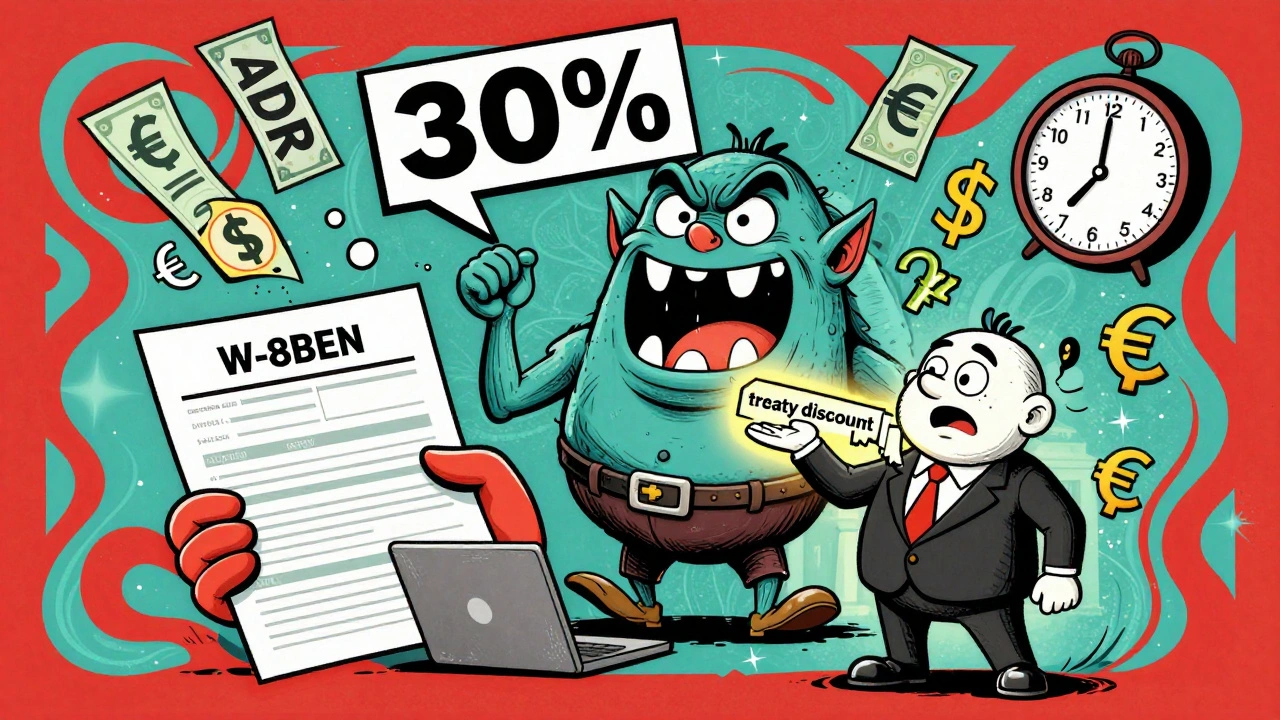
Foreign governments still withhold taxes on dividends. If your country has a tax treaty with the U.S., that rate might drop to 15%. Without a treaty? You could be paying 20-35%. The depositary bank doesn’t fix that. You have to file a W-8BEN form with your broker to claim treaty benefits. Many investors don’t. Fidelity’s survey found 68% of retail investors mistakenly thought ADRs eliminated all foreign tax withholding. That’s how people get surprise tax bills in April.
Who Uses ADRs-and Why?
ADRs aren’t just for retail investors. Pension funds, mutual funds, and hedge funds use them too. But the biggest users are everyday Americans who want global exposure without the hassle. According to FINRA, ADRs make up 15.7% of all foreign equity held by U.S. retail investors. Why? Because they’re easier.
A Fidelity survey showed 82% satisfaction among investors using ADRs versus just 63% for those who bought foreign stocks directly. The top reason? No need to open foreign accounts. No dealing with foreign language documents. No waiting weeks for dividends. One Reddit user, u/GlobalTrader87, shared a story about getting 15.2% tax withheld on his Alibaba ADR instead of the 10% treaty rate-because his broker didn’t process his W-8BEN form. That’s the kind of mistake ADRs help prevent… if you know what to do.
For companies, ADRs are a gateway to U.S. capital. The U.S. equity market is $50.3 trillion. If you’re a Brazilian tech startup or an Indian pharmaceutical firm, getting listed directly on the NYSE is expensive and complicated. An ADR lets you test the waters. Level 3 ADRs let you raise money. Level 1 lets you build brand recognition. Either way, you’re reaching millions of American investors.
What Could Go Wrong?
ADRs are convenient, but they’re not risk-free. One big issue: termination. If a foreign company decides to stop its ADR program, your shares get delisted. Robinhood reported over 12,450 ADR terminations since 2020. When that happens, you have to decide: sell the ADR at a potentially bad price, or transfer it to a broker that supports foreign shares. One user on Reddit paid $387 just to convert his terminated ADR into actual foreign shares.
Another risk? Unsponsored ADRs. These are created without the foreign company’s permission. They’re legal under SEC Rule 12g3-2(b), but they’re risky. The company doesn’t provide financials. The ADR might be based on outdated data. The SEC tracks 287 companies eligible for unsponsored ADRs-but most investors avoid them for good reason.
Then there’s regulation. The 2020 Holding Foreign Companies Accountable Act forced 15 Chinese ADRs to delist between 2022 and 2023 because they wouldn’t let U.S. auditors inspect their books. That sent shockwaves through the market. But new ADRs from Brazil, India, and South Korea have filled the gap. Emerging markets are growing their ADR presence at 12.3% per year.
What’s Changing Now?
ADRs are evolving. In March 2023, the SEC made it cheaper for foreign companies to register Level 3 ADRs by letting them use Form F-3-a simpler, faster process that cuts registration costs by about $750,000 per offering. That’s a big deal for mid-sized companies.
JPMorgan is testing blockchain-based ADR settlement, cutting settlement time from two days to near real-time for 12 European ADRs. That could reduce counterparty risk and make trading smoother.
Companies are also getting smarter about ADR ratios. Instead of matching the foreign share price, they adjust the ratio to hit the sweet spot for U.S. retail investors-usually between $10 and $100 per share. Siemens Energy’s 2023 ADR launch used a 10:1 ratio to hit a $35.50 price. That’s intentional. It makes the stock look more familiar to U.S. investors.
Meanwhile, 63% of EU-based ADR issuers now file financials in both IFRS and U.S. GAAP-up from 41% in 2019. That’s a sign of deeper integration between U.S. and global markets, even as geopolitics get tense.
How to Get Started
If you want to invest in ADRs, start by checking your brokerage. Most major platforms-Fidelity, Charles Schwab, Robinhood-support ADR trading. Search for the company name followed by “ADR.” Look at the level: Level 2 or 3 is safer. Read the prospectus if it’s available. Make sure you’ve filed a W-8BEN form with your broker to claim tax treaty benefits. And remember: ADRs simplify international investing, but they don’t eliminate risk. Currency fluctuations, political instability, and regulatory changes still matter.
Start small. Pick one or two companies you already know-Nestlé, Toyota, Samsung. See how they trade. Watch the dividends. Learn the fees. Then expand. ADRs are your easiest, safest path into global markets. You don’t need to understand foreign exchanges. You don’t need to speak another language. You just need to know what you’re buying.
Is This Right for You?
ADRs are ideal if you want:
- Exposure to foreign companies without opening overseas accounts
- Dividends in U.S. dollars
- Trading during U.S. market hours
- More transparency than OTC foreign stocks
They’re not ideal if you:
- Want to avoid all foreign taxes (you still pay some)
- Need voting rights in the foreign company (often limited)
- Are trying to time short-term trades in volatile emerging markets (ADR liquidity can drop)
For most U.S. investors, ADRs are the smartest way to go global. They remove the friction. They reduce the complexity. And they give you access to companies you can’t buy any other way.
Are ADRs the same as buying foreign stocks?
No. ADRs are U.S. receipts representing foreign shares, traded in dollars during U.S. hours. Buying foreign stocks directly means dealing with foreign exchanges, currencies, taxes, and brokerage accounts. ADRs simplify the process but come with their own fees and risks.
Do ADRs pay dividends in U.S. dollars?
Yes. The depositary bank converts foreign dividends into U.S. dollars and distributes them to ADR holders. However, foreign governments may withhold taxes before the dividend reaches the bank.
Can I lose money on ADRs even if the foreign company is doing well?
Yes. Currency fluctuations, ADR termination events, regulatory changes, and depositary bank fees can all impact your returns-even if the underlying company is growing. ADRs track the foreign stock, but they’re not a perfect copy.
How do I know if an ADR is sponsored or unsponsored?
Sponsored ADRs are created with the foreign company’s approval and usually have better disclosure. Check the company’s investor relations page or the SEC’s EDGAR database. Unsponsored ADRs are created without company involvement and are listed under Rule 12g3-2(b). They’re riskier and harder to research.
What’s the difference between Level 1, 2, and 3 ADRs?
Level 1 trades OTC with minimal SEC reporting. Level 2 lists on major U.S. exchanges and files annual reports but can’t raise capital. Level 3 can raise money in the U.S. and must meet full SEC disclosure rules. Level 3 is the most transparent and liquid, but also the most expensive for companies to maintain.
Do I need to file a W-8BEN form for ADRs?
If you want to claim a lower dividend withholding tax rate under a U.S. tax treaty, yes. Without it, the default rate is 30%. Most brokers will ask you to complete this form when you open your account or buy your first ADR.
Are ADRs safe?
ADRs are as safe as the underlying company and the level of disclosure. Level 2 and 3 ADRs from stable countries are generally low-risk. Level 1 and unsponsored ADRs carry higher risk due to limited information. Always research the company’s financials and regulatory status before investing.
Kenny McMiller
December 4, 2025 AT 16:40ADRs are essentially financial abstraction layers-like a proxy for equity ownership that decouples you from the messy realities of foreign markets. It’s a neat hack, really: the depositary bank becomes the intermediary that handles currency, custody, and compliance, letting retail investors bypass the entire infrastructure of global settlement systems. But here’s the kicker-this convenience comes at the cost of opacity. You’re not owning Toyota shares; you’re owning a contractual claim on a bundle of Toyota shares held in Tokyo, mediated by JPMorgan. The SEC’s Level 1 vs. Level 3 distinction isn’t just bureaucratic-it’s a spectrum of trust. Level 1? More like a rumor with a ticker symbol. Level 3? That’s a legally binding covenant with transparency baked in. And let’s not forget the silent tax vampire: foreign withholding. Most folks don’t realize their ‘dollar dividends’ are already 15-30% smaller before they even hit their account. W-8BEN isn’t optional paperwork-it’s your tax shield. Skip it, and you’re just donating to foreign treasuries.
Dave McPherson
December 5, 2025 AT 19:45Ugh. Another ‘ADRs are easy’ tutorial for people who think ‘global investing’ means typing ‘Samsung’ into Robinhood and calling it a day. Look, if you’re actually serious about international exposure, you don’t need ADRs-you need a brokerage that lets you buy real shares. ADRs are for people who want the illusion of diversification without doing any work. And don’t get me started on Level 1 OTC garbage-those are basically financial fan fiction. Companies use them to look like they’re in the U.S. market while dodging SEC scrutiny. Meanwhile, the depositary bank pockets fees on every dividend like a toll booth on the information superhighway. If you’re holding an ADR and you don’t know what Form 20-F is, you’re not an investor-you’re a spectator at a magic show where the rabbit is someone else’s pension fund.
Julia Czinna
December 7, 2025 AT 18:27I appreciate how clearly this breaks down the levels and risks. I’ve held Nestlé and L’Oréal ADRs for years and never realized how much the tax withholding varied until I filed my W-8BEN last year. It cut my foreign tax bite in half. Also, the point about ADR ratios is spot-on-I never thought about how companies adjust the share ratio to hit that $10–$100 sweet spot for U.S. retail investors. It’s such a subtle but smart behavioral nudge. Honestly, if you’re just starting out, stick to Level 2 or 3. The extra transparency is worth the slight liquidity trade-off. And yes, ADRs aren’t perfect, but compared to the alternative of juggling euros, yen, and rupees? They’re the least painful path.
Laura W
December 7, 2025 AT 23:16ADRs are the gateway drug to global investing. You start with Nestlé because it’s familiar, then you’re like ‘wait, I can own a piece of a Brazilian fintech? A South Korean chipmaker?’ Boom-suddenly your portfolio isn’t just Apple and Tesla. And yes, the fees suck, and the taxes are sneaky, but you know what’s worse? Missing out because you thought ‘foreign stocks = too complicated.’ I’ve seen so many people skip emerging markets entirely because they don’t want to open a foreign account. ADRs let you dip your toe without jumping into the deep end. Also, the blockchain settlement stuff JPMorgan’s testing? That’s the future. Real-time ADR settlement could kill a ton of counterparty risk. We’re not just talking convenience here-we’re talking infrastructure evolution. If you’re not paying attention to ADRs, you’re not paying attention to the next decade of global finance.
RAHUL KUSHWAHA
December 8, 2025 AT 06:25Thanks for sharing this. Very helpful. 😊